The long-awaited family reunion was a huge success.
Last weekend, my parents, Mary Ann and her husband Mike, Kristin, Bryce, me, Philip and Jason all made our way out to Hadley, PA, where Arnetta lives. Arnetta is the daughter of Anna Mae Brenckle, Raymond and Myrtle’s daughter.
It was funny for me because I looked at the Brenckles, who weren’t really all that different looking than all the rest of us (lots of dark hair, brown eyes, hearty appetites). But you could also see how the branch that belonged to “the Italian boys” (that’s how so many people remembered them, as “the Italian boys”) was so different.
I met (or re-met) Brenckles of all ages. That was great, because I had several direct connections to people with clear memories of my grandfather — including Arnetta’s older sister.
As I sat with the two of them, another memory of the type of person my grandfather was floated up.
“I remember one time hearing a story from my mother,” Arnetta said. “From right after your grandparents got married. Your Grammy, bless her heart, she was so wonderful. But she didn’t know anything about running a house. Oh, none of us do when we get married. But she served dinner to your grandfather. And he said to her ‘Helen, look in my ear.’ All concerned, she starts looking in Phil’s ear and asking what’s the matter. ‘Do you see a noodle in there?’ he asks totally straight-faced. ‘No, Phil. I don’t.’ she says, totally serious. ‘Well, look again, because that’s the fourth time we’ve had chicken soup this week and I think the noodles are starting to come out of my ears.'”
I can feel the grin split my face. It’s nothing, really. No grand historic import to this story. But it’s an absolute lock on what kind of person my Grandpa Phil was. This was a man who grew up in an era, and possibly around people, who’d have knocked the pot out of Grammy’s hands and no one — not even her — would have thought it was wrong. But not only did he not treat her like that, his gentle humor made her not feel bad about herself. I wanted to hug him so bad. Heck. I wanted to hug Grammy again and laugh with her over the sweet memory she’d never seemed to find all those times I’d asked.
“Do you want me to bring down some pictures?” Arnetta asked.
I practically raced to the attic myself. The box held a bunch of loose photos and old frames. There were a lot of pictures we’d already had. The dapper picture of Grandpa in his 20s, straw boater in hand, dressed in a sharp gray suit. It’s a strange feeling, seeing “your” family picture in someone else’s house. But, obviously, they were family, too.
There were many others I hadn’t seen. Myrtle sitting on an upturned vegetable box at the stand on Smallman Street. Grandpa and Joe in coveralls, standing in front of a greenhouse they’d built. Promotional photos of the Brenckle farm trucks.
And on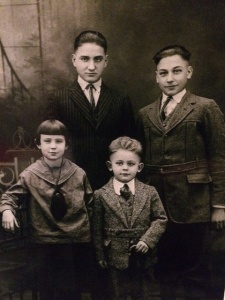 e picture that twisted my heart when I saw it. Phil and Joe in obviously-new suits, standing next to 8-year-old Anna Mae and 4-year-old Buddy, the Brenckles’ biological son.
“It must have been taken right after the adoption was finalized,” Arnetta said. Sure enough, another photo, of all the kids in the same clothes, standing in front of a large, black car on the Brenckle farm, seemed to verify it.
There were pictures of the old Brenckle farmhouse and the new. The old one burned down, but they rebuilt. One of the guys I met tonight lives there now.
“You know, guys, there’s one thing I’ve always wanted to know. Why?” I asked. “Why them?”
Arnetta and her sister explained that the Brenckles took in a lot of kids for farm work. They took in a lot of adults, too. It’s likely that their being as young, but as old, as they were at the time they came to the farm made them perfect candidates to watch Anna Mae and Buddy.
“Oh,” I said. It sounded like a work arrangement.
“But there was something about your grandfather and his brother,” Arnetta said. “They were special. They had good senses of humor. They were hard workers.”
 “They were helpful and handy?” I said.
Remember, Ray and Myrtle adopted them, they said. They didn’t have to. They could have just let them live on the farm, because there were a few other kids and older guys that did. They made them family, and that had to mean something.
It wasn’t the grand, movie-ending I’d hoped for. “You’re the missing piece of our family” and all that. Emotions, I suppose, weren’t the same in 1922 as they are now.
And I learned one more thing. Mary was always welcome. She was never adopted, but she was still a large part of the family. It seems cruel, but for a working farm, her disability would have been difficult; and again, feelings about those types of things were very different from today. Raymond, in fact, used to drive over to the Fresh Air Home, pick Mary up and bring her for the weekend. She’d sit in the kitchen and snap green beans or dry dishes. And after all the work was done, the three siblings could spend time together.
That, I imagine, had to mean everything.
 findingphilblog
Leave a comment