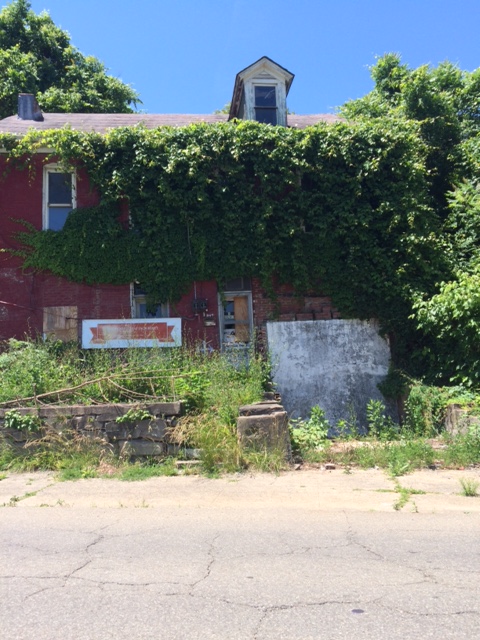
I stepped out of the car, closed my eyes and breathed deep. I was finally here, in a place I had no idea I needed to be.
The Christmas letters had proved conclusively that Phil and Joe spent time living with their uncle, Ottavio Brescia, in Bellaire. It was only for nine months, and not only did they not look back, they erased their uncle and the town from their existence.
So, there I stood, a Venezia renamed and returned to discover whether the contours of the brief, sad life Phil and Joe lived here were still visible after almost 100 years.
The answer was yes and no.
Buildings remain. The old bank, which was still under construction in the summer of 1923, towers eight stories over the downtown landscape. The soot-stained viaduct sits sentinel, dividing the town from its outskirts, but has long fallen into disuse. The massive Imperial Glass factory that employed half the town is two decades gone, replaced by a shopping center. The house 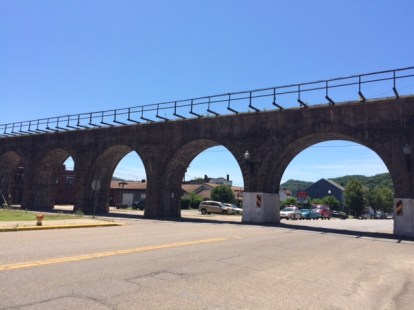 where Phil and Joe lived with their uncle — just across the street from the factory — is gone as well.
Bellaire itself seems a bit sad, in the way that all small towns that have lost their economic heartbeat are. I know from my research that there are committed groups of citizens working to make it better for the 4,000-plus souls who still call it home. You can see it in the splashes of fresh paint and newly-made signs interspersed among the boarded-up storefronts.
I said it’s been just under 100 years since a Venezia set foot here, but the Brescias never left. And so, a walking dichotomy, I set off in search of the past. I begin at the Bellaire Public Library.
Ottavio had a life after the boys. The Census from 1930 shows him as the proprietor of his own grocery store. The father of two young sons married for many years. In quick succession, I discover his boys grew up here and had families of their own. Father and both sons are buried in the cemetery nearby. I comb through microfiche, hoping for photos.
I discover one of Ottavio’s sons, John. He would be my dad’s first cousin, once removed. One look and I am reassured that the Brescias I’ve chased here are the right ones. From Severina through to me — it’s the eyes and that chin!


Excited, I spill the Cliff Notes version of the story to the librarians. With equal fervor, they dip back into their own memories to tell me that John was known as “Bushy” and worked the toll bridge. Chester, who died young (50) had a snack food business. And they remember Ottavio selling groceries up at his little store on the hill. The house is still there, they said. It’s being gutted and rebuilt as another Bellaire landmark – The House that Jack Built. One of them went to school with John’s daughter. I peer curiously at her yearbook photo and wonder at the outline of our shared history staring back.
When I hit the tiny branch library’s limit of resources, I wander around the town, eventually landing at the Imperial Glass Museum. A sweet couple with honey-dipped Southern accents leads me through the small rooms filled with display cases. I tell them about the letter Grandpa wrote back to Mrs. Brenckle, detailing his work at an unnamed factory, and they promise to pour through their old ledgers to see if he’s listed. I can’t resist buying a candy dish — Washington/Mount Vernon pattern. It would have been made during the year Grandpa was here.
Jason, playing devil’s advocate, likes to remind me that perhaps my sainted Grandpa and his brother were little twerps, mouthy and ungrateful as teenage boys can be. That maybe they were the lazy ones, refusing to do a man’s work and still wanting to run around like little boys.
I wonder, too. Absent people are always the easiest to love. You have nothing to go on but expectation and supposition; it’s a relationship uncomplicated by human interaction.
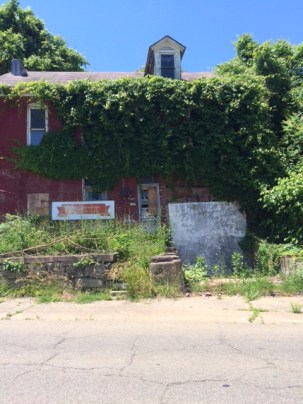 I take a drive by the Hamilton Street house Ottavio called home for many years. I linger just long enough to snap a picture from the air-conditioned comfort of my SUV. I grin at the absurdity of scrawny, beat-up Phil’s granddaughter rolling through town in a shiny black car, pointing her pocket computer at a crumbling monument to the past.
As I roll back toward Pennsylvania, I take stock of my expedition. I’ve had hit richer veins of primary source material. Emotionally, however, I hit the mother lode. I found kindness, helpfulness and the neighborliness only a small town can bring. From Phil’s letters, I know he, too, found patches of beauty among the ruin. That’s real. That’s the best I can ask for.
 findingphilblog
Recent Comments