Search

findingphilblog

In search of my grandfather's past … and maybe a book deal

Author

larabrenckle

In 2006, I began to make good on the childhood promise I made my Grammy. I would discover the truth about my Grandpa Phil's life. No one -- not my father, my aunt or my extended family -- could imagine the story I uncovered. This is the story of how one girl met the grandfather she never knew, and loved him even more because of what she found. The Ground Rules All photographs and research materials are copyright to their respective owners or Lara Brenckle. All blog copy, as well as the story of Phil Brenckle's life, is copyright to Lara Brenckle. All information here is presented in a journalistic format. Reactions are to discoveries made as I uncovered them. I reserve the right to revise and correct those impressions based on new material. Anyone having alternate theories is welcome to present them in the comments. Like any good journalist, I am always open to a correction. Corrections will be handled with a new post stating that it is a correction to previous information, but previous information may not be deleted. This blog is a record of a personal discovery and that path takes many, many turns.

Hold my Hand

I woke up smiling, because I never expected to meet him there.

My Grandpa Phil died 14 years before I was born. Unlike my Grammy Helen, Grandpa and Grandma Krajenke, he and I had no shared experiences that might cause my sleeping subconscious to toss up a memory disguised as a dream.

Which makes what happened last night all the more magical.

I love all my grandparents. In the years since their passing, I’ve met them again in the oddest, but always joyous, moments. An unexpected whiff of Opium perfume that appeared from nowhere (Hi, Doris!); a crystal-clear, post-meditation vision of my tanned, grinning Grandpa Richard, waving from a swimming pool; Grammy sending me pennies in unexpected places and dream notes. Even my excellent Uncle Rick, who died too early in 2007, nudged me over the radio with a song by his beloved Beatles on or near the anniversary of his passing. But over the 20 years of working on “Three Rivers Home,” I’d come to understand that Grandpa Phil likely wouldn’t appear in my dreamscapes because he’d been sadly absent from my childhood.

Until last night, which coincidentally happened to be the 103rd year since the morning he awoke to the horrors of the Brenckle Farm Fire.

It was the first time, ever, that I dreamed of Grandpa Phil. In that distant kingdom, he was hale, hearty, and healthy. I’ve never heard his voice, but when he spoke, I was sure it was true — Pittsburghese, tinged with an Italian-American childhood. I don’t remember much, other than being so excited to see him. We were in the Pittsburgh of today, a modern world of autonomous vehicles on Grant Street and the PPG building ascending, in all its chrome-shining glory, to the sky. The city, compressed in that dream-like way, made the Kaufmann’s Clock intersection across the street from PPG Place.

More than anything, I wanted to bring him home, to the house he built, where, in my dream, I knew my cousins, brother, mom, dad and aunt waited with Grammy. “Let’s tell her!” the dream me said. “She’s going to be so excited.”

And then, as we prepared to cross the street, he took my hand. My last thought before waking was, “I can’t believe it! I’m holding Grandpa’s hand.”

I awoke. It was 3 a.m. I chuckled softly in the darkness, exhaling the surprised thrill I’d drawn in the dream.

This, like the Christmas letters, the photo or the dozens of little twinkling outposts of hope along the way, serves as a sign — to me, anyway — that those we love never truly leave us, even if that love transcends mortality.

Found, Together

It still doesn’t feel real. Twenty years after I put my head down on a lonely desk in an empty newspaper office and pulled it up with his image burning across my brain, this journey Grandpa Phil and I took together meets its incredible conclusion. I have a book deal.

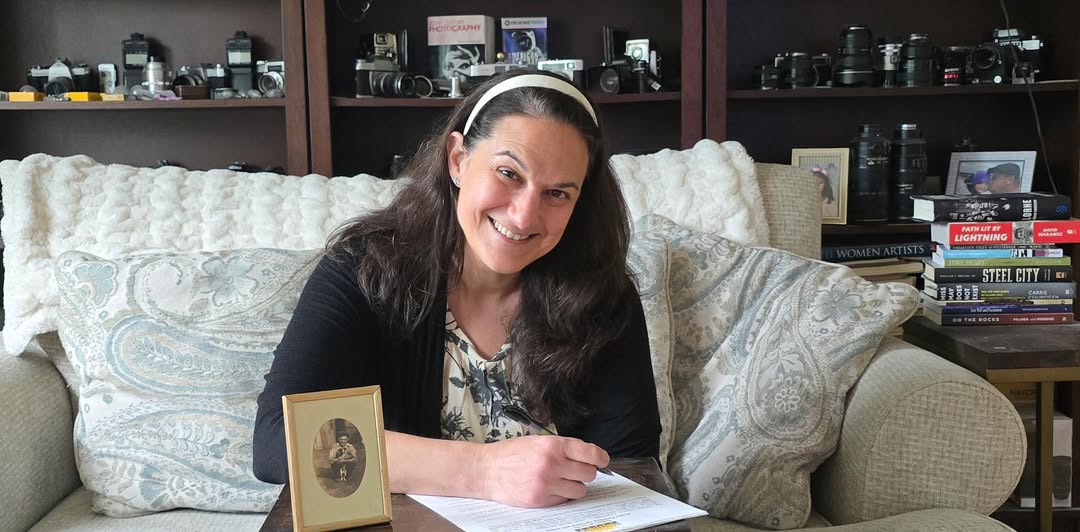
On May 13, I signed with Sunbury Press to publish Three Rivers Home.

While there’s still so much to do (developmental editing, more beta reads, fact-checking), I’m reveling in the joy this moment brings.

It will be real, on a shelf, just like the thousands of books that shaped my childhood and adulthood. What’s more, in seeing a little boy who lost everything thrice over survive, readers might find strength to get through their hardest days.

Last week, I got to share I the happy news with my amazingly supportive friends at Pennwriters during our annual conference. It was at the 2024 event in Lancaster that I met Lawrence Knorr, Sunbury’s CEO, and pitched my manuscript. Returning to Pittsburgh, where I’d begun pitching, was an especially sweet, full-circle moment. The talented colleagues I’ve met through Pennwriters are an invaluable source of inspiration, information and generosity. One theme running through Three Rivers Home is finding where you belong. Like stepping through the doors of Ursuline Academy, onto the portico at the E.W. Scripps School of Journalism or into newsrooms across Pennsylvania, there’s something soul-settling about gathering with my fellow writers.

So, what have I learned across two decades, thousands of hours, multiple rejections and more than one computer disaster that almost ate all my hard work? The same thing Grandpa Phil did: Just.Keep.Going.

Satisfying endings aren’t guaranteed. It’s only in looking back that all the connections seem to point toward success. In reality, nothing’s certain — except that giving up ensures failure.

The family Grandpa and Grammy created remains. Not all in Pittsburgh, but we are together, living in a future I’m not sure either could imagine. The family his story created — through writing groups, compassionate beta readers, encouraging friends and helpful historians — will add new members as the book launches (date to be determined.)

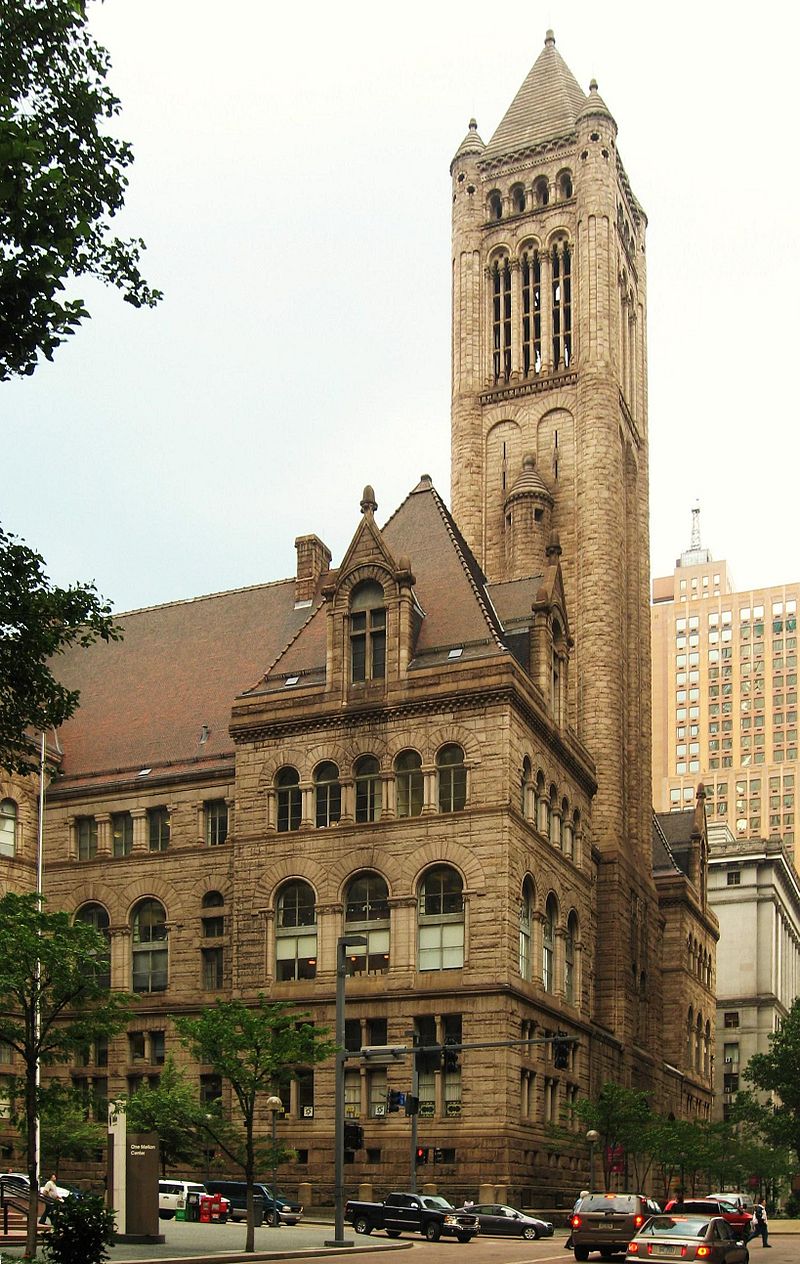
Music has been another constant through this journey. From Phil’s mysterious, one-time performance of “Sweethearts on Parade” to the “Hamilton” and “Moana” soundtracks that soothed the pandemic’s depths and inspired me to keep trying. It wasn’t a surprise when a song I’d long forgotten found me again. “Almost Home,” off Mary Chapin Carpenter’s “Party Doll and Other Favorites” album, rang out as the Squirrel Hill Tunnel’s darkness gave way to a bright May morning shining over the city view that never fails to take my breath away. It’s an amazing feeling, isn’t it? Knowing whatever journey you’ve completed is past, and you’re returning to a place of safety and rest. I imagine, had it existed in 1924, the words would have resonated with Phil and Joey, too. As the horrors of their childhood receded, the boys walked out of Allegheny County Courthouse as part of a family and headed back to Troy Hill. They weren’t running. They weren’t hiding. They were almost home.

Signs and Wonders

It is real now. I officially began querying agents on Thursday, March 14, the 113th anniversary of Grandpa Phil’s birth (and about three years later than I thought). Our project, going out into the world under the title Three Rivers Home, is a work of love. Love for my family. Love for a grandpa I never got to know in life, but found after his death. He never got to take me fishing or show me how to change a tire, but Philip Leo Brenckle, the gentle soul who grew from the scared little boy named Filippo Arturo Venezia, taught me how to catch a dream.

It’s a luxury he glimpsed but never grasped. Grandpa yearned to turn his talent for making Donahoe’s fruit baskets—topped by fantastic, complex bows—into a business. We’re alike in that way, Francesco, Phil, and me. Whether it’s tailoring, basket-making, or writing, using our structured creativity is the essence of freedom.

As I set out on the toughest leg of this journey, Grandpa — once again via my Aunt Mary Ann — let me know he’s watching and rooting along with the rest of the family.

Mary Ann and my uncle Buck live in the family home and have been remodeling it. The basement’s being turned into a full bathroom because, like so many Pittsburgh houses, it’s got a “Pittsburgh Potty” and shower. And, tucked under the steps leading from the basement to the first-floor kitchen is Grandpa’s workbench. It’s sat untouched since he died in 1964. The mysterious concertina, upon which he played only once in memory, belting out Louis Armstrong’s “Sweethearts on Parade,” is lodged in a cubby beneath its broad top, still scattered with baby food jars of nails, brackets, washers, and nuts. Little did we know the bench concealed a secret relic of Phil’s deferred dream.

On March 14, at about the same time I was composing query letters to my first two agents, Mary Ann and Buck pulled back the bench.

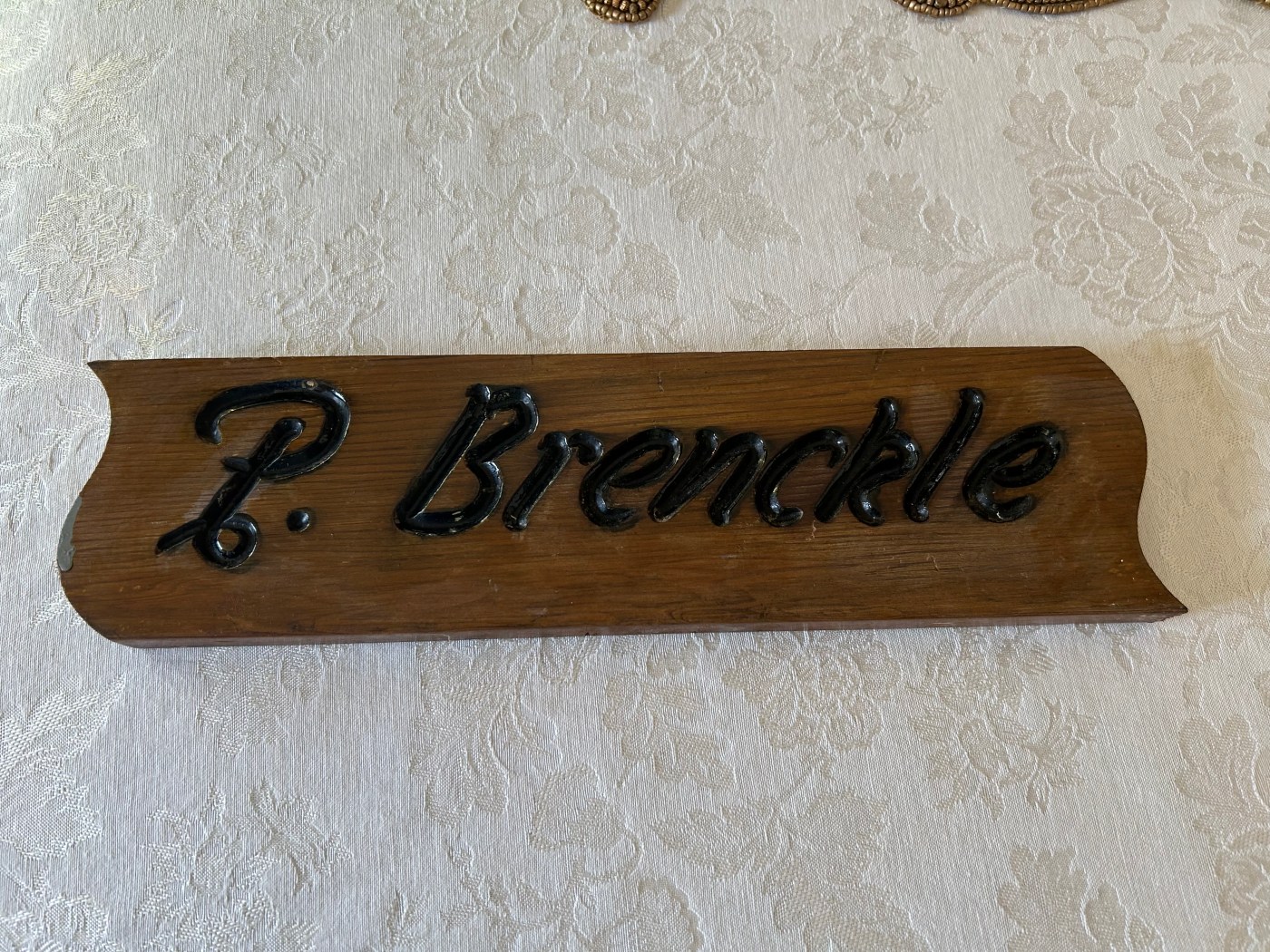
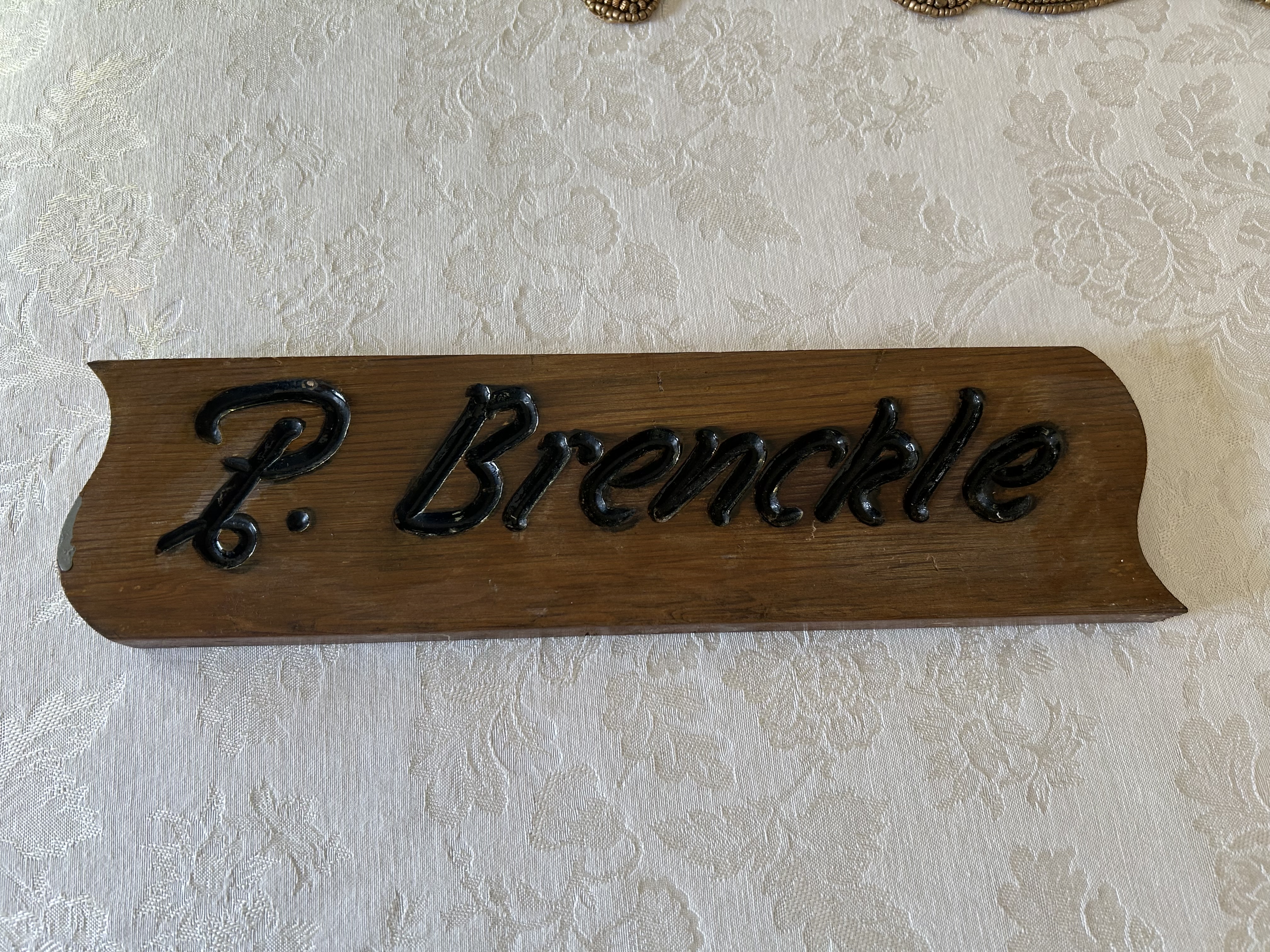
Behind it was this wood-burned sign, as close as Grandpa got to becoming the proprietor of his own fruit basket business, which he’d planned to start at the Brenckles’ Garden Center on Babcock Blvd.

My parents happened to be in Pittsburgh last weekend for an event, and Mary Ann presented it to them. Of course, it will go to my brother and grandpa’s namesake, where it belongs.

So, thanks again, Grandpa, for reminding us that you and Grammy are still watching and cheering for the next generation’s success.

The Things She Carried

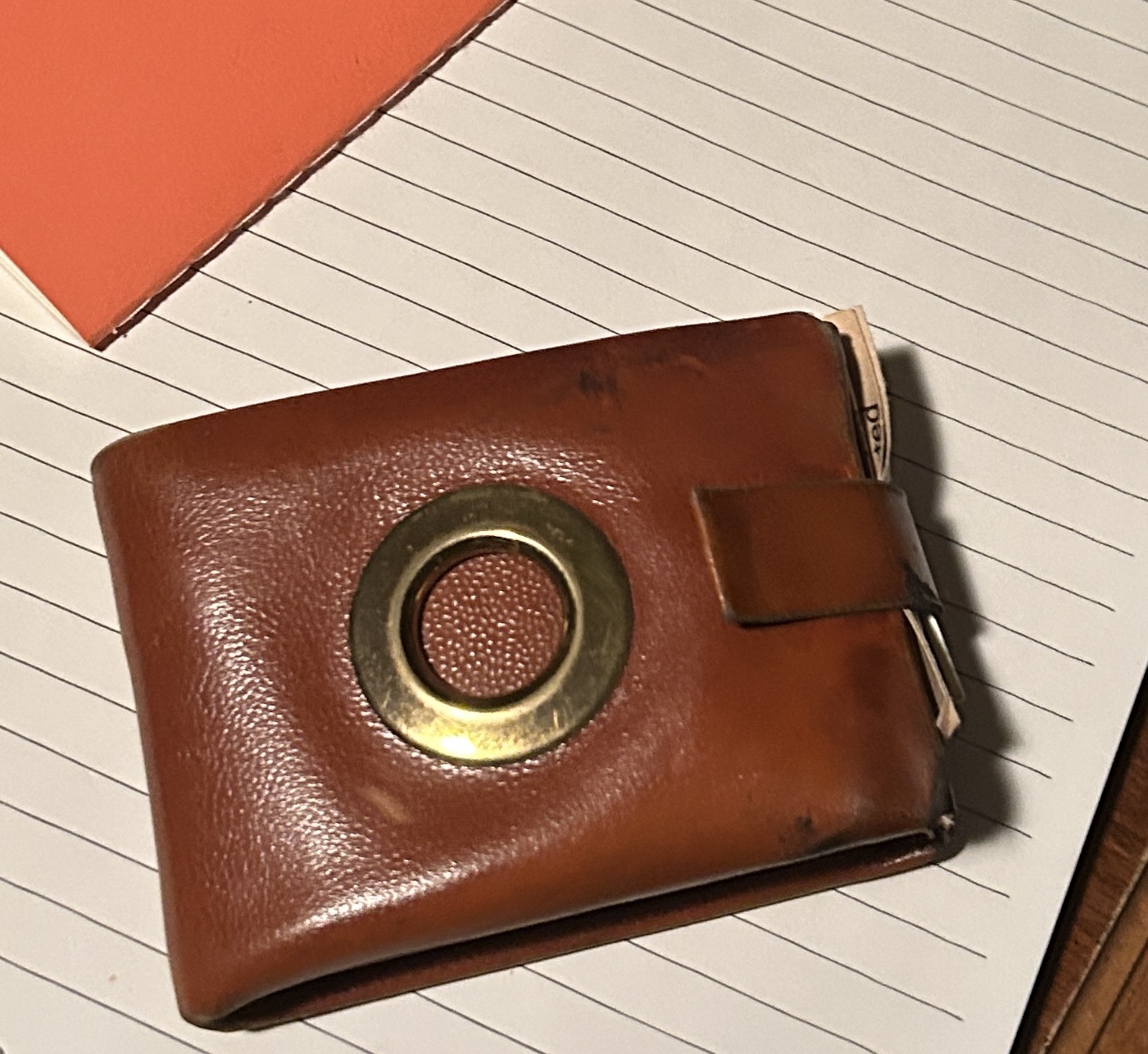
My Mom handed me a small, brown wallet, clasp tantalizingly closed as if its owner had just placed it on the nightstand.

“I figured you’d want this,” she said, “It was Aunt Mary Vee’s.”

Mary “Vee,” my great-aunt, Mary Venezia, was the last link to Grandpa Phil, Great-Uncle Joe, and their parents. As the oldest child, she had the clearest memories of nearly all their shared tragedies. By the time she died at 73, she’d outlived her parents and siblings despite a congenital hip defect and tuberculosis that settled in her bones with spine-twisting brutality.

I say nearly because, in 1920, Mary’s destiny diverged from her brothers’. When they were pulled, sick and starving, from Pasquale’s hovel in Pittock, Phil and Joe went into Allegheny County’s rudimentary foster care system while Mary was sent to the Sewickley Fresh Air Home. A cross between Shriner’s Hospital and St. Jude’s, it provided care to children 14 and younger, mostly with polio, tuberculosis, and orthopedic complications. Someone — possibly Mary’s caseworker Camilla Barr — was looking out for her and negotiated 15-year-old Mary a place there, paid for by the county.

Despite having her family and heritage severed repeatedly, Mary saved pieces of her fragmented past with tender, orderly ferocity. She preserved the only photograph of Francesco and Severina, Francesco’s memento mori pin, and her baby picture.

With an archivist’s practiced eye, I unclipped the wallet’s slim band.

My Dad’s face, forty years younger, stared back from a pair of newspaper clippings announcing promotions at Pittsburgh National Bank, followed by two of Dad’s business cards with elegant, Palmer-script notations indicating he was her emergency contact.

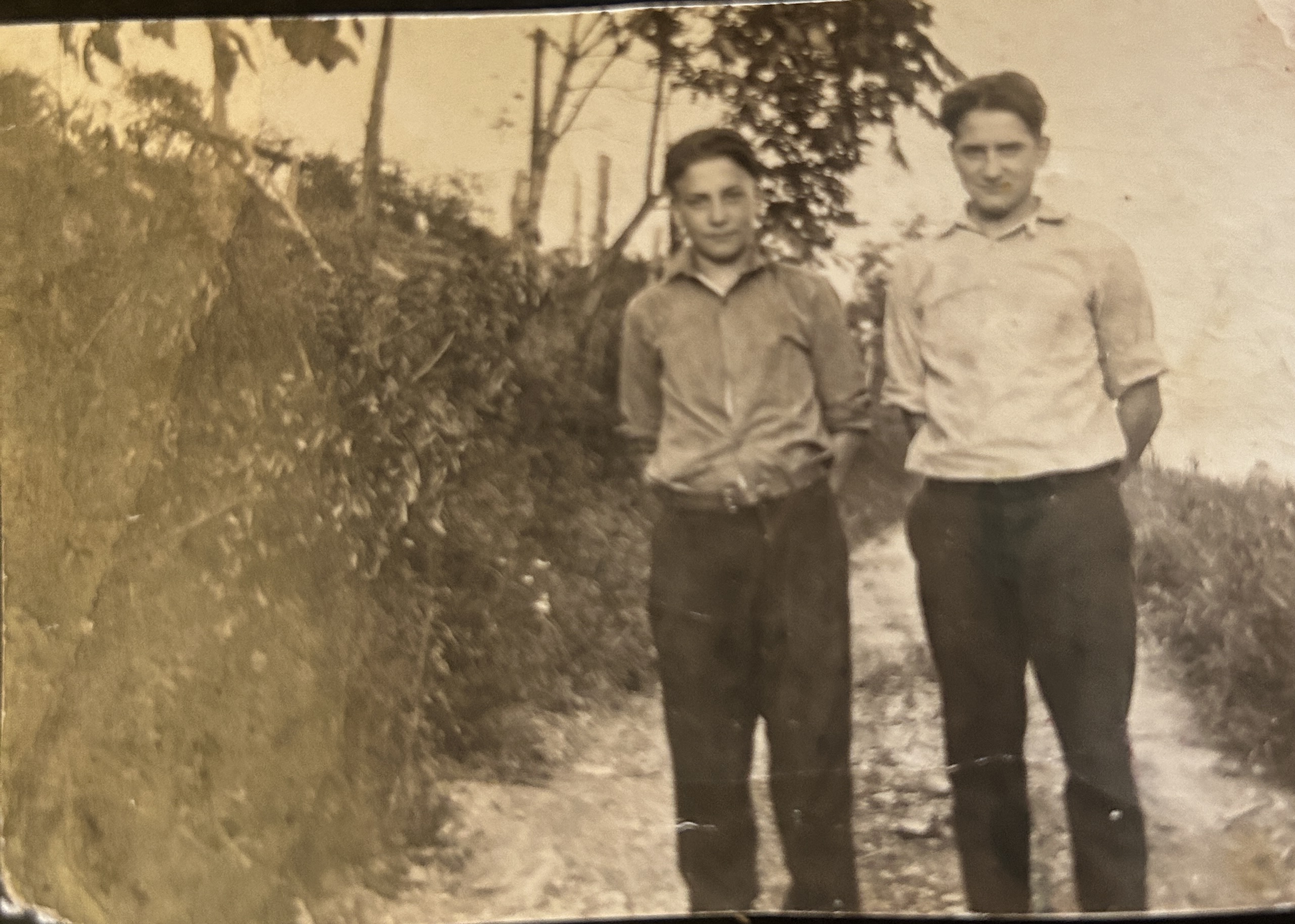
Next, to my surprise, was a photo of Joe and Phil. Taken the same day as another photo in my collection, I recognize the Brenckle farm lane in the background and conclude it was most likely after they’d returned from Bellaire. Their smiles are tighter, eyes shifting slightly left as if still on guard for danger. In faded pencil, Mary’d written on its back, “Phil and Joe in working clothes.”

Next came high school graduation photos of my Aunt Mary Ann and Joe’s children, Myrtle and Wayne; my cousin, Bryce, her first great-grand-nephew, at four months old.

Then, her social security (issued in 1970), health care (Blue Cross of Western PA), and voter registration (Republican) cards.

Finally, a small collection of strangers’ babies, graduation, and wedding photos. Every image, however, was marked with names, dates, and short descriptions. It was a reminder that Mary was not only a vital part of our family’s history but a sweet memory in so many others.

The 1951 Pittsburgh Press article about the Fresh Air Home noted that after healing, she’d remained there as a kindergarten teacher and was known to sit up nights holding the hands of new arrivals who missed their families.

Those little boys and girls remembered dear Miss Mary and wrote to her by the dozens over decades. At one point, we had a large bag filled with hundreds of black and white photos, clippings, and notes former Fresh Air residents sent. Babies, graduations, enlistments, and homecomings were all shared with the woman who’d been the friend they needed. I’d uncovered it in my parents’ closet at about age 10 and sifted through it endlessly. Several boys healed enough to be drafted into World War II. One sent photos from Eagle’s Nest, Berchesgarten, and several locations mentioned in Band of Brothers.

There were also photos of Mary and her Fresh Air friends having fun. After all, she was a young woman and emerged from three years of body casts with humor and an effervescent spirit. One letter preserved in the Bellaire stash included a note from Mary to Phil mentioning playing tricks on her doctor by stuffing newspaper in his shoes. Within the Fresh Air Home’s sprawling grounds, she strummed a ukelele, hosted little girls’ tea parties, and reenacted scenes from plays. Tragically, this cache fell victim to a basement flood and couldn’t be preserved, much like the Fresh Air Home itself.

Medicine and society moved from institutionalization to community care. The home shuttered in 1952, and Fresh Air’s wealthy benefactors gave Mary one final gift — a room at Friendship House, a genteel retirement home for upper-class ladies. However, her stay was contingent upon remaining mobile and self-reliant.

And for decades, she was. Until, one day, she wasn’t. The stately Sewickley Victorian, with her room on the top floor, was no place for a woman with severe spinal degeneration. A doctor convinced her surgery would save her mobility. Dad tried to talk her out of it, hearing chicanery’s quack a mile away. However, Mary, who’d fought valiantly for independence, decided to go down swinging. Complications predictably, fatally arrived.

Before she left this world, Mary learned my Mom was pregnant with me. She was overjoyed to know her favorite nephew, who looked so much like his father — the little brother she loved so much — would be a father himself. In a way, her precious, tiny collection of our family’s founding documents paved the way for all the research I conducted years later.

Mary, ever the teacher, also hid a final lesson in her tightly packed wallet. Its collection of family and friends reminds us that opportunities to treat others with kindness, mercy, respect, and love come to us all. Ripples of those choices reach untold generations, bearing memories that become blessings.

Apologia

Severina

I owe my great-grandmother an apology.

For more than a decade, I’ve shaken my fist at her. What kind of mother makes the choices she did? How could she not know? Didn’t she see?

It took a global pandemic for me to realize that, for Severina Brescia, there were no choices. Choice implies agency and options. For Severina, there were only reactions to unfolding horrors, which, she hoped, would be the least bad thing.

Marry a neighbor? At least her children had a “father” with an income. Realize the new husband is an abusive jerk? Send the children to their uncle. At least they are with family.

She hoped all would be well, and it wasn’t. I wonder, in the agonizing month it took for her to die from “childbed fever” contracted during her fourth and final birth if she was cognizant enough to spend time on recrimination. I hope she didn’t; I’m sorry that more than 100 years later, I did.

I’ve always said that interpretations of this life-long research project would be re-evaluated in the face of new evidence. While no new facts have come to light, a broader emotional understanding has.

As COVID-19 spreads on a wave of governmental failure and fear, our family faced its own crossroads: Do my daughter and I shelter with my parents while my husband, a newspaper photojournalist, continues to serve his community?

There was no good answer.

What if we weren’t infected? Why part when we could be together, safe at home? Still, each day he returns from assignments, the 14-day exposure clock clicks over afresh.

Even worse, what if I was already infected? In leaving my house, would I infect my parents? How could I live with myself if I did that?

Finally, if I wasn’t sick and he wasn’t sick, and the wave of infections hadn’t crested, now could be the last chance for safety. At least, for Jillian and I. Maybe.

In the end, Jason’s grandfather helped us decide.

In 1911, as pogroms savaged Ukraine and Jews like Nathan Malmut were hunted down, Jason’s paternal grandfather slipped the borders and found passage on a New York-bound ship. Nathan had no way of knowing that he had just 18 months to get out of the country and bring his wife, Sarah, and their year-old son, Ben, to freedom. By 1912, they were reunited in America.

A tiny fragment of family, saved by a split-second decision in a sliver of time. The Malmuts, also had no choices — only reactions — chanced an ocean and the world that lay beyond. We like to romanticize immigration tales as if our ancestors made these leaps the same way we pick travel itineraries or pursue career moves to big cities. It’s a fallacy. As someone so succinctly put it during a more recent immigration wave: “No one puts their children in boats unless the water is safer than land.”

Invariably, the decision that saved Nathan, Sarah and Ben — and made the lives of Esther, Anna, Saul, and Jason’s dad, Bruce (born Seymour) possible — came with bitter knowledge. Between the first and second World Wars, the Jews of Kakhovka, Ukraine, bore witness to mass executions. Wikipedia offers information about blood-libel cases and expulsions before World War I here. Yad Vashem has a history of its existence during World War II here. Though we have not discovered their names, it is almost certain some of Jason’s blood relatives perished in these atrocities.

That said, a viral epidemic is not a holocaust. What we, as a nation, are being asked to do pales in comparison to what was imposed upon impoverished, hunted people in the face of war and extreme human rights violations.

Still, by drawing strength from the stories of our ancestors, our family was able to do the one thing Severina Brescia and Nathan Malmut couldn’t: Make a choice. So, for now, we live apart, hoping every day for a speedy reunion.

Severina faced widowhood with a deceased mother, a father a continent away and three brothers, each as hapless as the next. It was her, 2,000 bucks and a lifetime of decisions for which she was not equipped emotionally, legally or economically.

So, Severina, across the ages, I am sorry. Sorry I judged you so bitterly. Sorry I couldn’t see through my own privilege. I am staring into history myself. My husband and I are making choices we hope are the right ones. We pray they can save our family. I hope, wherever you are, you can forgive me.

The final frontier

800px-AlleghenyCountyCourthouseThroughout this journey, a single primary source document remained shrouded in secrecy: Phil’s adoption file.

The idea of searching for it ebbed and flowed. I’d been told it would likely contain nothing — if it existed at all. More than 100 years have passed since Phil, Joe and Mary entered Allegheny County’s care. Warehouses flood. Paper folders get mislaid. Don’t get my hopes up, I was told. The “file” could hold no more than a single paper with his name on it.

I know better, by now, than to trust supposition. And, honestly, the folks at the Office of Children, Youth and Family and the Clerk of the Orphan’s Court could not have been more helpful.

This spring, I decided to cross the legal Rubicon. No matter what was inside, be it reams of paperwork or a single card, it would be an answer.  

Technically, my dad had to make the request. As Phil’s living son, he has standing before the court. So, together, we wrote the letters, collected the documents (including a certified copy of Phil’s death record) and sent them off to Pittsburgh. 

In mid-September, the Clerk of the Orphan’s Court presented our plea. Judge Lawrence O’Toole affirmed Dad’s standing and appointed Children, Youth and Families to act as our search agent.

What, if anything, would they find?

The answer came today: nothing less than the final pieces confirming the shape of this decade-long jigsaw puzzle.

The timeline is accurate. Assumptions were proven out by the legal paper trail and augmented by the amazing Christmas letters and the diligence of the city’s journalistic community.

The half-remembered boogyman, woven ominously through time as The Uncle in Ohio has a name. Ottavio Brescia. So do his two accomplices. Mike Natale. Pasquale Brescia.

There were only a handful of documents in Phil’s file, but they were good: The adoption decree and the Brenckles’ petition to adopt the boys. Law (still!) seals the file and prevents direct photocopying. However, our search agent was kind enough to hand-copy it all and provide a summary.

The final sentence punches me in the gut. 

img_8761.jpg

 Oh, people “looked after” them. Just not well. Not with love. Their relatives watched as three beautiful children, who’d lost the two most important people in their lives, starved, sickened and almost died. These men saw dollar sign-printed punching bags. 

To be sure, there are sacks of waste wrapped in skin who do that, and worse, to children living on our street, going to school with our kids, standing in line next to you at the gas pump today.

This journey with my grandfather gifted me invaluable lessons. Chief among them is the urgent need to protect all children and improve the nation’s foster care and adoption system which, in many communities, fails badly and often. 

In terms of sleuthing, this is the end of the road. The mystery I carried from childhood through middle age has been solved. The names have not been changed, here anyway, to protect the guilty or the innocent. 

Here’s another thing I’ve learned, thanks to my writer’s critique group and a raft of writing manuals. The truth may be stranger than fiction, but it won’t always make a great novel. 

So, that’s the next horizon. The mystery is replaced by this riddle: How to write this incredibly personal story well enough so others believe its value? So much so that, in turn, will help the rest of the world see and love this long-ago, almost-lost little boy. 

Music, again, fills my soul with hope. In the movie Coco, little Miguel journeys to the Land of the Dead, hoping to solve a mystery mirroring my own: what happened to his great-grandfather?  

The final scene makes me weep. Mystery solved, Miguel’s living family celebrates All Souls Day. Spirits from generations past, beckoned by a photo-laden ofrenda (altar), visit the courtyard. 

Miguel bursts into song:

“Last night, it seemed, that I dreamed about you/ When I opened my mouth/what came out was a song/and you knew every word/and we all sang along/ to the melody played on the strings of our souls/And a rhythm that rattles us down to our bones/Our love for each other/will live on forever/in every beat of my proud corazon.” 

The lessons here, and there, are clear. Memory is powerful. Love can be almost magic, extending protection through generations. You are never too young, or old, to learn something new or reexamine your understanding of the past. 

Onward. 


I will get back up again

IMG_8046

When you live in a house with two artists, crazy ideas routinely unfurl. That’s when one of us turns to the other and shrugs: “You can’t wrestle if you don’t weigh in.”

Well, after almost 13 years of research and five years of writing, it was time. Heart in my throat and Hamilton‘s “My Shot” roaring in my ears, I took Grandpa’s story to the annual Pennwriters convention. It was, in all places, Pittsburgh. On the same weekend I’d already booked an Italian genealogy course at Heinz History Center. A course led by — gasp — a man named Rich Venezia (who was wonderful and, sadly, no relation.) Surely, fate was on my side.

And it seemed, for a moment, like it was. I pitched two agents. Both enthusiastically asked for pages. A lot of them. This was it, I thought. All those years of work, and I’ll bang it out the same way I did Jeopardy! — nailing the audition on the very first try.

To quote the marvelous Julia Sweeney — God said Ha.

A pitch, a swing and a miss. The first agent said no thanks. The concept was fascinating. There was the little problem, however, of not having developed it well enough. She was sweet and wonderful and absolutely professional in every way. She invited me to re-pitch if I reworked it. This is more than generous.

The two-page critique at the conference, and then a critique group a month later all coalesced to a single truth: I was not as ready as I thought. I’m not going to reach out to the second agent until I am.

Oddly enough, it was Jillian who convinced me not to. When I told her things hadn’t worked out, I asked her “What do you think, baby? Should mommy send her story, or wait and make it better.”

With guileless eyes, she stared into my soul and said “make it better, Mommy.” Who can argue with that? Plus, if this adventure taught me anything, it’s that slowing down can sometimes make everything move faster a bit later. So, now it’s time to take my time — something that is never easy.

Speaking of easy, Jason likes to remind me of another truth. If it was easy, everyone would do it.

So instead of reaching Everest, I’ve tumbled all the way back to the Kathmandu airport, pack in hand, wondering if I’m nuts to even try such a thing.

So, I do what I always do. I buy more books.

Fix Your Story. The 2019 Writer’s Market. Pull out the books on self-editing I borrowed from Valerie years ago. Because I made the cardinal mistake many new, aspiring authors do — thinking that a great true story and mastery of other styles translates to literary success. It very, very rarely does. Like letting go of all my journalism hang-ups so I could learn to write for business, I’m reaching for a new editorial horizon. 

Sometimes, the questions seem insurmountable. I could take the story this way. Or that. What is right? No one can tell me. It is trial and error upon error upon error. It is not for the faint of heart.

But my heart’s pretty good. It stands in the place of Phil’s broken one.

At the very least, I’m always telling Jillian it’s the effort that matters. In the words of one her favorite songs (from the movie Trolls) “if you knock/knock/me over/I will get back up again.” What’s true for a five-year-old is surely true for her 41-year-old mom, right?

Philip Leo, Filippo Arturo

He would have been 110 today.

There are a lot of assumptions in that sentence. That he would have made it this long. That he’d be one of those knobby-kneed Italian men, drinking wine and toasting his still-dark hair.

As it was, he got a bit more than half of that.

I watch my father with my little girl and I ache all over again for the hole in my life — and in his life, my aunt’s and Grammy’s — the combined negligence and abuse of Ottavio, Pasquale and Mike Natale created. For the bad luck of needing heart surgery just as effective modern techniques were being developed.

He had crazy strokes of good luck for so long. Luck he used to push his brother farther. His sister to more safety. His wife to a safe harbor of a loving man. To stay as long as he could for the children whose 1950s-era Baby Boom world he couldn’t understand, but loved just the same. Sometimes, I feel that luck has been passed down the way his chin has. I just wish a little had been left over for him.

But maybe, just maybe, he felt lucky to be where he was, just as he was.

I am so close to the end. I’d hoped to be done by now. I’d set a goal long ago to mark Grandpa’s 110th birth anniversary with a completed novel and open the search for an agent. But. Life gets in the way. Raising a child and working full time at a great and busy job gets in the way.

I get to thinking that I dip my toe into his world, and he lived it every day. I can take a break from it. He never did.

So. I course-correct. Re-commit to getting done, even if it means less sleep for a while. People have lived with worse.

The Bellaire chapters are hard. They are dark and angry and fraught with tension. Sometimes, I sit in front of my computer, hand to mouth, not wanting to write the next natural thought that proceeds from all the research I’ve done. There is hope, but I see, through the glass darkly, how far away it seemed.

So I turn to music to power through.

Lately, the two albums on heavy rotation have been the work of Broadway wunderkind Lin-Manuel Miranda. Hamilton, and the Moana soundtrack.

I choke back tears every time I hear the chorus of the closing song “Who lives, Who dies, Who Tells Your Story?” 

Because that’s what this is, isn’t it? 110 years past his birth, 53 years past his death, I am telling his story. I am making judgments about who is worthy of honor, and who fails at humanity. Are they right? Are they the same ones he would have made? I hope so. I keep remembering that these people are not characters. They were human beings, with complex lives that leave them neither damned sinners nor glorious saints. Except maybe you, Mike Natale. Except maybe you.

And then there’s Moana. The story of a girl who longs to know who she is. Who feels pulled by forces she doesn’t understand until she realizes that what she is isn’t weird. She’s exactly who she’s supposed to be. And the quest she goes on to find herself, it’s epic.

In a lot of ways, these ten years, they’ve been my quest. To fill in the missing pieces of three generations of souls. I know it’s folly to think I alone can bind wounds that were never mine to manage. Still, the words of the movie resonate. “And the call wasn’t out there at all; it’s inside me.” 

I almost don’t want all this writing and researching to end. In the movie, just when Moana is about to give up, her Grandma Tala appears. And I’m in tears again because not only does it remind me of Grammy, it makes me miss her so. I know that Phil is right there next to her. For 10 years, they’ve been right there. I got married. I had a baby. I changed jobs. There were times when I thought that what I was doing was stupid and a waste of time. That this will never see the light of day and even it if does, it won’t be good enough.

But.

I’ve spent 10 years in his company. 10 years knowing so much more about him than I did the day I put my head down on my desk in my miserable office in Pittsburgh and pulled it back up with his name ringing in my brain.

Over and over, his memory has raised my head and challenged me to live the life he started but never got to finish.

To quote another Hamilton lyric, “that would be enough.”

Because his name, Joe’s name, Mary’s name. They mean one thing. Love. I can’t speak for all families. I only know mine. But there’s a truth there. Love will come from somewhere. Family will come from somewhere. It can tear you apart, but it can also literally save your life. Phil’s blood betrayed him. A stranger held out hope and a hand. It changed the course of 10 lives and counting.

Over and over again, it’s come back to me.

Lin’s amazing, immortal pronouncement. A truth I see in 110 years of history.: Love is love is love is love.

A peek into the past

Still writing, still revising. But in the meantime, the Pittsburgh Post-Gazette has given me a beautiful gift — a glimpse inside the now-abandoned Our Lady Help of Christians. It’s sad to see something that was such a vital part of the community come to ruin like that. But the photography here shows how grand the church must have been. It’s even easier to imagine, now, what it was like when my great-grandparents walked under those arches. How my grandfather and his siblings must have strained their necks to look at the stained glass windows or follow the shadow of the sun across the pillars.

Blog at WordPress.com.

Up ↑