Search

findingphilblog

In search of my grandfather's past … and maybe a book deal

Category

Discoveries

Signs and Wonders

It is real now. I officially began querying agents on Thursday, March 14, the 113th anniversary of Grandpa Phil’s birth (and about three years later than I thought). Our project, going out into the world under the title Three Rivers Home, is a work of love. Love for my family. Love for a grandpa I never got to know in life, but found after his death. He never got to take me fishing or show me how to change a tire, but Philip Leo Brenckle, the gentle soul who grew from the scared little boy named Filippo Arturo Venezia, taught me how to catch a dream.

It’s a luxury he glimpsed but never grasped. Grandpa yearned to turn his talent for making Donahoe’s fruit basketsβ€”topped by fantastic, complex bowsβ€”into a business. We’re alike in that way, Francesco, Phil, and me. Whether it’s tailoring, basket-making, or writing, using our structured creativity is the essence of freedom.

As I set out on the toughest leg of this journey, Grandpa — once again via my Aunt Mary Ann — let me know he’s watching and rooting along with the rest of the family.

Mary Ann and my uncle Buck live in the family home and have been remodeling it. The basement’s being turned into a full bathroom because, like so many Pittsburgh houses, it’s got a “Pittsburgh Potty” and shower. And, tucked under the steps leading from the basement to the first-floor kitchen is Grandpa’s workbench. It’s sat untouched since he died in 1964. The mysterious concertina, upon which he played only once in memory, belting out Louis Armstrong’s “Sweethearts on Parade,” is lodged in a cubby beneath its broad top, still scattered with baby food jars of nails, brackets, washers, and nuts. Little did we know the bench concealed a secret relic of Phil’s deferred dream.

On March 14, at about the same time I was composing query letters to my first two agents, Mary Ann and Buck pulled back the bench.

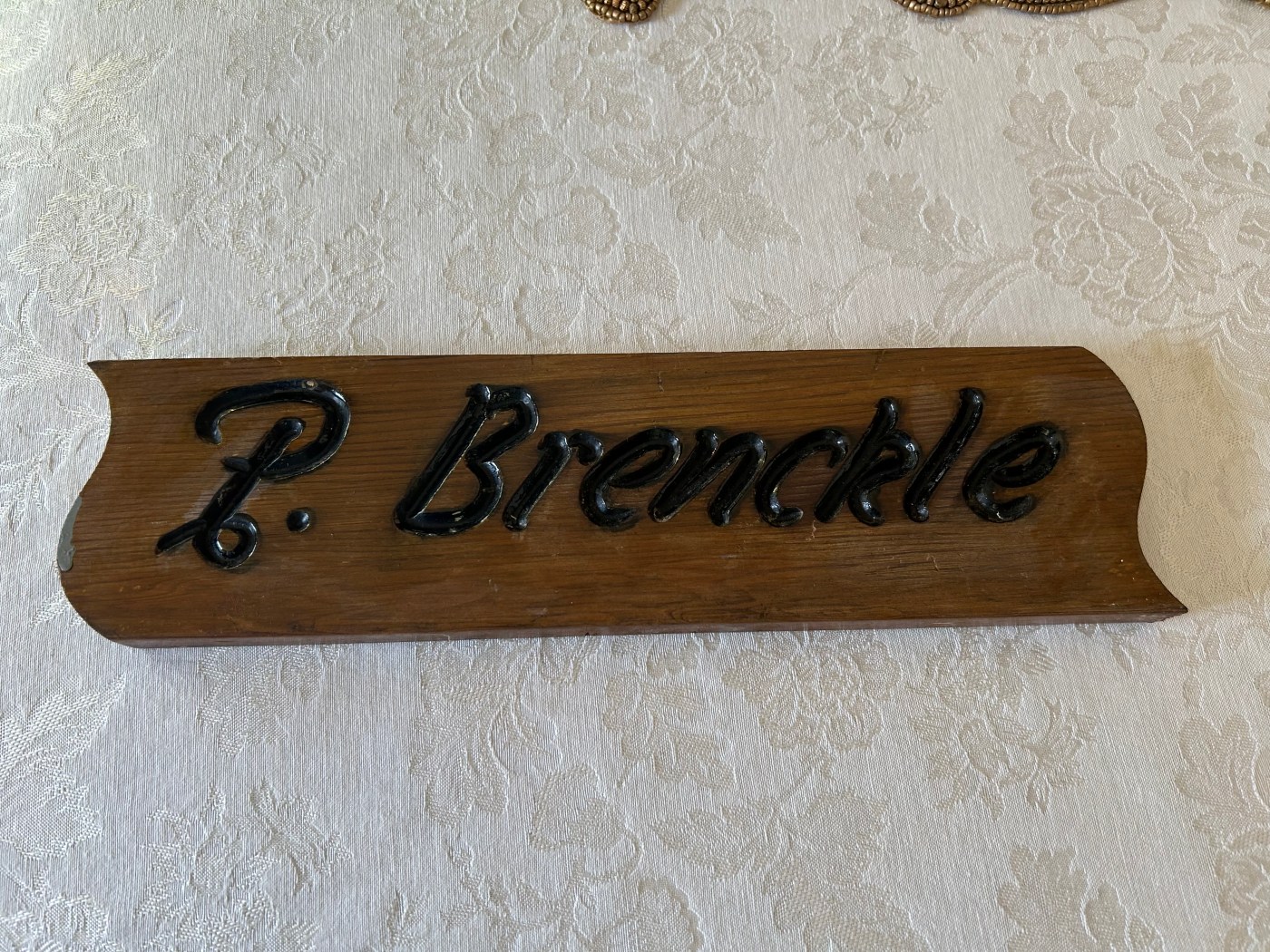
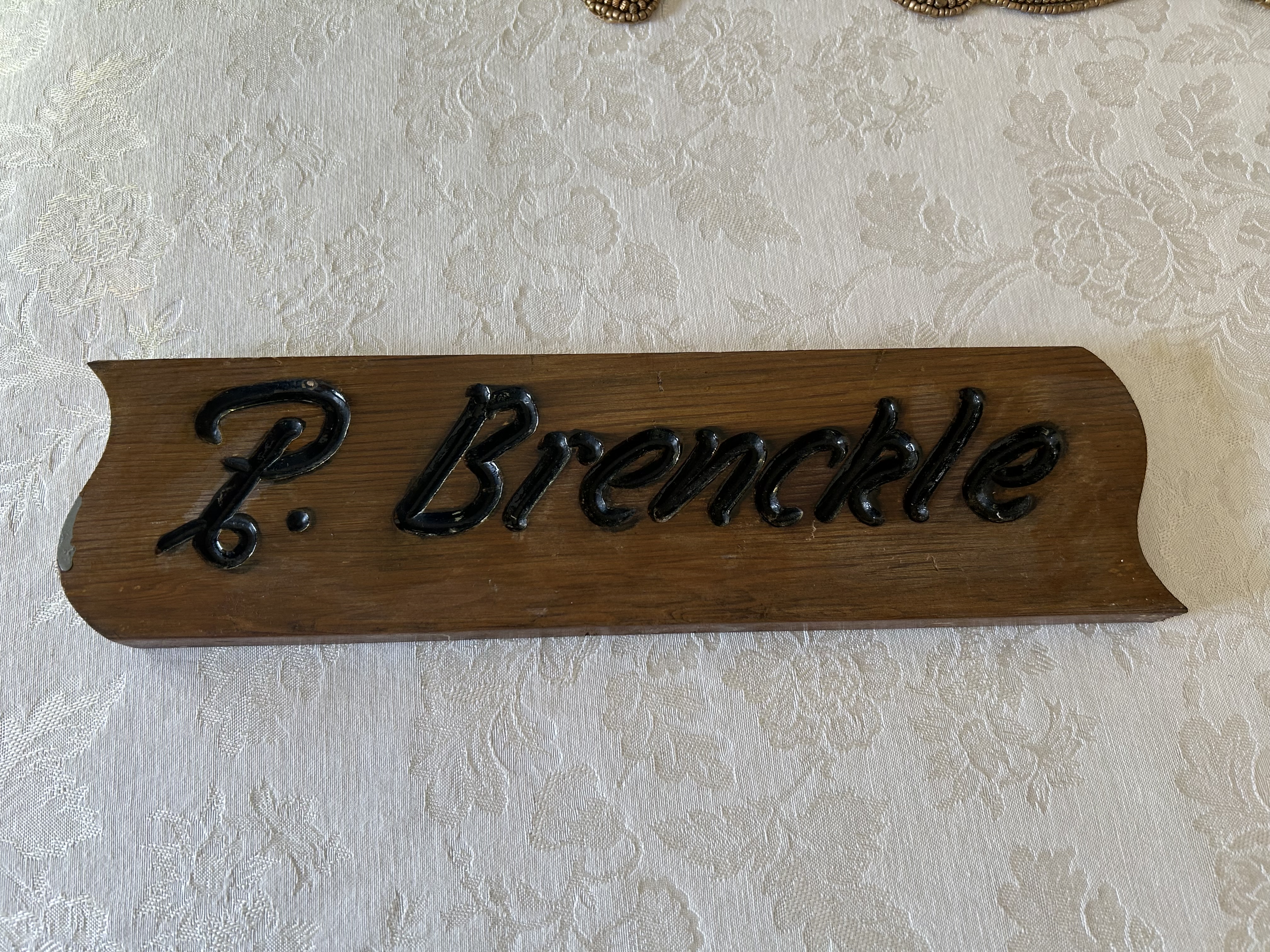
Behind it was this wood-burned sign, as close as Grandpa got to becoming the proprietor of his own fruit basket business, which he’d planned to start at the Brenckles’ Garden Center on Babcock Blvd.

My parents happened to be in Pittsburgh last weekend for an event, and Mary Ann presented it to them. Of course, it will go to my brother and grandpa’s namesake, where it belongs.

So, thanks again, Grandpa, for reminding us that you and Grammy are still watching and cheering for the next generation’s success.

The Things She Carried

My Mom handed me a small, brown wallet, clasp tantalizingly closed as if its owner had just placed it on the nightstand.

“I figured you’d want this,” she said, “It was Aunt Mary Vee’s.”

Mary “Vee,” my great-aunt, Mary Venezia, was the last link to Grandpa Phil, Great-Uncle Joe, and their parents. As the oldest child, she had the clearest memories of nearly all their shared tragedies. By the time she died at 73, she’d outlived her parents and siblings despite a congenital hip defect and tuberculosis that settled in her bones with spine-twisting brutality.

I say nearly because, in 1920, Mary’s destiny diverged from her brothers’. When they were pulled, sick and starving, from Pasquale’s hovel in Pittock, Phil and Joe went into Allegheny County’s rudimentary foster care system while Mary was sent to the Sewickley Fresh Air Home. A cross between Shriner’s Hospital and St. Jude’s, it provided care to children 14 and younger, mostly with polio, tuberculosis, and orthopedic complications. Someone — possibly Mary’s caseworker Camilla Barr — was looking out for her and negotiated 15-year-old Mary a place there, paid for by the county.

Despite having her family and heritage severed repeatedly, Mary saved pieces of her fragmented past with tender, orderly ferocity. She preserved the only photograph of Francesco and Severina, Francesco’s memento mori pin, and her baby picture.

With an archivist’s practiced eye, I unclipped the wallet’s slim band.

My Dad’s face, forty years younger, stared back from a pair of newspaper clippings announcing promotions at Pittsburgh National Bank, followed by two of Dad’s business cards with elegant, Palmer-script notations indicating he was her emergency contact.

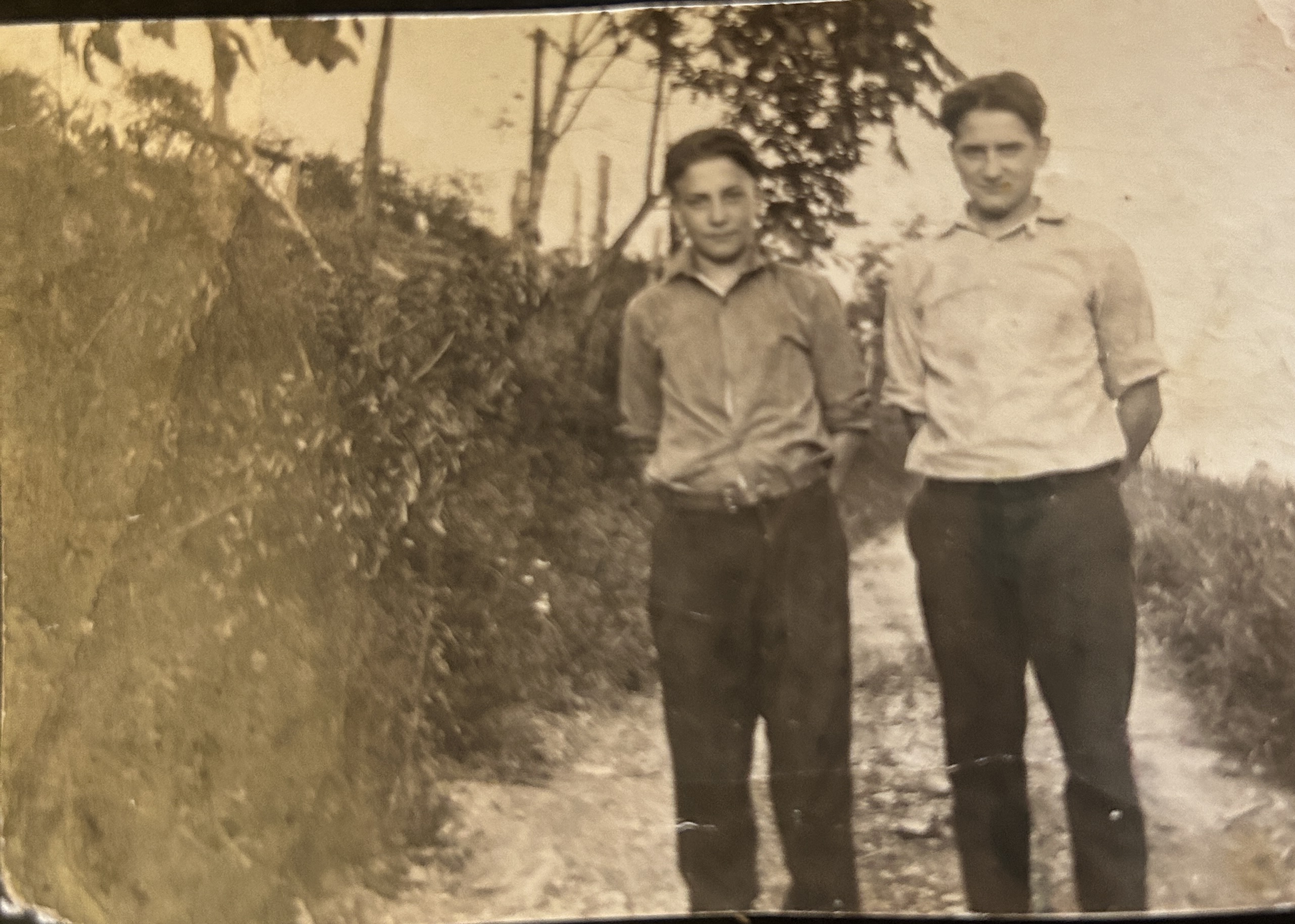
Next, to my surprise, was a photo of Joe and Phil. Taken the same day as another photo in my collection, I recognize the Brenckle farm lane in the background and conclude it was most likely after they’d returned from Bellaire. Their smiles are tighter, eyes shifting slightly left as if still on guard for danger. In faded pencil, Mary’d written on its back, “Phil and Joe in working clothes.”

Next came high school graduation photos of my Aunt Mary Ann and Joe’s children, Myrtle and Wayne; my cousin, Bryce, her first great-grand-nephew, at four months old.

Then, her social security (issued in 1970), health care (Blue Cross of Western PA), and voter registration (Republican) cards.

Finally, a small collection of strangers’ babies, graduation, and wedding photos. Every image, however, was marked with names, dates, and short descriptions. It was a reminder that Mary was not only a vital part of our family’s history but a sweet memory in so many others.

The 1951 Pittsburgh Press article about the Fresh Air Home noted that after healing, she’d remained there as a kindergarten teacher and was known to sit up nights holding the hands of new arrivals who missed their families.

Those little boys and girls remembered dear Miss Mary and wrote to her by the dozens over decades. At one point, we had a large bag filled with hundreds of black and white photos, clippings, and notes former Fresh Air residents sent. Babies, graduations, enlistments, and homecomings were all shared with the woman who’d been the friend they needed. I’d uncovered it in my parents’ closet at about age 10 and sifted through it endlessly. Several boys healed enough to be drafted into World War II. One sent photos from Eagle’s Nest, Berchesgarten, and several locations mentioned in Band of Brothers.

There were also photos of Mary and her Fresh Air friends having fun. After all, she was a young woman and emerged from three years of body casts with humor and an effervescent spirit. One letter preserved in the Bellaire stash included a note from Mary to Phil mentioning playing tricks on her doctor by stuffing newspaper in his shoes. Within the Fresh Air Home’s sprawling grounds, she strummed a ukelele, hosted little girls’ tea parties, and reenacted scenes from plays. Tragically, this cache fell victim to a basement flood and couldn’t be preserved, much like the Fresh Air Home itself.

Medicine and society moved from institutionalization to community care. The home shuttered in 1952, and Fresh Air’s wealthy benefactors gave Mary one final gift — a room at Friendship House, a genteel retirement home for upper-class ladies. However, her stay was contingent upon remaining mobile and self-reliant.

And for decades, she was. Until, one day, she wasn’t. The stately Sewickley Victorian, with her room on the top floor, was no place for a woman with severe spinal degeneration. A doctor convinced her surgery would save her mobility. Dad tried to talk her out of it, hearing chicanery’s quack a mile away. However, Mary, who’d fought valiantly for independence, decided to go down swinging. Complications predictably, fatally arrived.

Before she left this world, Mary learned my Mom was pregnant with me. She was overjoyed to know her favorite nephew, who looked so much like his father — the little brother she loved so much — would be a father himself. In a way, her precious, tiny collection of our family’s founding documents paved the way for all the research I conducted years later.

Mary, ever the teacher, also hid a final lesson in her tightly packed wallet. Its collection of family and friends reminds us that opportunities to treat others with kindness, mercy, respect, and love come to us all. Ripples of those choices reach untold generations, bearing memories that become blessings.
The final frontier

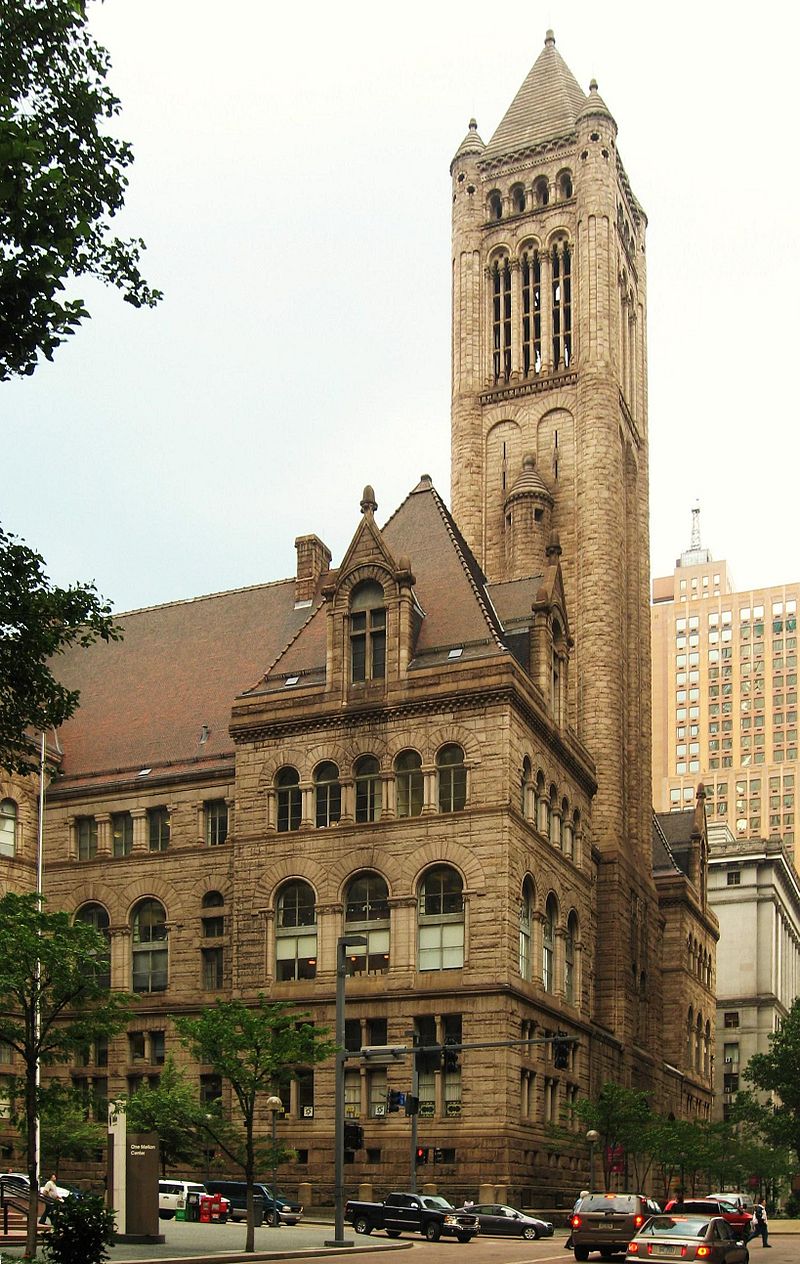
800px-AlleghenyCountyCourthouseThroughout this journey, a single primary source document remained shrouded in secrecy: Phil’s adoption file.

The idea of searching for it ebbed and flowed. I’d been told it would likely contain nothing — if it existed at all. More than 100 years have passed since Phil, Joe and Mary entered Allegheny County’s care. Warehouses flood. Paper folders get mislaid. Don’t get my hopes up, I was told. The “file” could hold no more than a single paper with his name on it.

I know better, by now, than to trust supposition. And, honestly, the folks at the Office of Children, Youth and Family and the Clerk of the Orphan’s Court could not have been more helpful.

This spring, I decided to cross the legal Rubicon. No matter what was inside, be it reams of paperwork or a single card, it would be an answer.Β Β 

Technically, my dad had to make the request. As Phil’s living son, he has standingΒ before the court. So, together, we wrote the letters, collected the documents (including a certified copy of Phil’s death record) and sent them off to Pittsburgh.Β 

In mid-September, the Clerk of the Orphan’s Court presented our plea. Judge Lawrence O’Toole affirmed Dad’s standing and appointed Children, Youth and Families to act as our search agent.

What, if anything, would they find?

The answer came today: nothing less than the final pieces confirming the shape of this decade-long jigsaw puzzle.

The timeline is accurate. Assumptions were proven out by the legal paper trail and augmented by the amazing Christmas letters and the diligence of the city’s journalistic community.

The half-remembered boogyman, woven ominously through time as The Uncle in Ohio has a name. Ottavio Brescia. So do his two accomplices. Mike Natale. Pasquale Brescia.

There were only a handful of documents in Phil’s file, but they were good: The adoption decree and the Brenckles’ petition to adopt the boys. Law (still!) seals the file and prevents direct photocopying. However, our search agent was kind enough to hand-copy it all and provide a summary.

The final sentence punches me in the gut.Β 

img_8761.jpg

Β Oh, people “looked after” them. Just not well. Not with love. Their relatives watched as three beautiful children, who’d lost the two most important people in their lives, starved, sickened and almost died. These men saw dollar sign-printed punching bags.Β 

To be sure, there are sacks of waste wrapped in skin who do that, and worse, to children living on our street, going to school with our kids, standing in line next to you at the gas pump today.

This journey with my grandfather gifted me invaluable lessons. Chief among them is the urgent need to protect all children and improve the nation’s foster care and adoption system which, in many communities, fails badly and often.Β 

In terms of sleuthing, this is the end of the road. The mystery I carried from childhood through middle age has been solved. The names have not been changed, here anyway, to protect the guilty or the innocent.Β 

Here’s another thing I’ve learned, thanks to my writer’s critique group and a raft of writing manuals. The truth may be stranger than fiction, but it won’t always make a great novel.Β 

So, that’s the next horizon. The mystery is replaced by this riddle: How to write this incredibly personal story well enough so others believe its value? So much so that, in turn, will help the rest of the world see and love this long-ago, almost-lost little boy.Β 

Music, again, fills my soul with hope. In the movie Coco, little Miguel journeys to the Land of the Dead, hoping to solve a mystery mirroring my own: what happened to his great-grandfather?Β Β 

The final scene makes me weep. Mystery solved, Miguel’s living family celebrates All Souls Day. Spirits from generations past, beckoned by a photo-laden ofrenda (altar), visit the courtyard.Β 

Miguel bursts into song:

“Last night, it seemed, that I dreamed about you/ When I opened my mouth/what came out was a song/and you knew every word/and we all sang along/ to the melody played on the strings of our souls/And a rhythm that rattles us down to our bones/Our love for each other/will live on forever/in every beat of my proud corazon.”Β 

The lessons here, and there, are clear. Memory is powerful. Love can be almost magic, extending protection through generations. You are never too young, or old, to learn something new or reexamine your understanding of the past.Β 

Onward.Β 

Β Β 

News from Pittsburgh

PasqualeDCCaptureThis was in the Pittsburgh Post-Gazette a few days ago.

I, of course, was intrigued by the appearance of Woodville, as that is the hospital where Pasquale died.

There’s a lot of political feeling around institutionalization, so we’re not debating that here. But what is sad is as these facilities are closed, there are many graves that are abandoned.

One never knows when the family history bug will bite, but one of the hardest things to hear as you research is “Oh! If you had come X years or months or days ago. We just threw it out/it got torn up/the place got demolished.” You kick yourself endlessly for not getting started sooner.

I reached out Sam Sirabella, the man mentioned in the article as possibly having information about Woodville. He did a record search for me and couldn’t find anything on Pasquale Brescia. As Father DeVille notes in the article, the site contains 1,064 graves. My great-uncle is very likely among them.

The article reminds me that I haven’t looked for Pasquale among the newly released PA death records. It doesn’t take me long to find him. There’s not much that I don’t already know here. I’ve got lots of other records confirming much of what’s there. But there are a few nuggets, the largest of which is that whomever wrote out this death certificate seemed much more inclined to accuracy. It now appears that Pasquale, Ottavio, Saverina and Cesare’s father was named Cesare Brescia. Their mother was Fillipina Oliva. Now there is consistency among the records for at least these two siblings. I feel comfortable updating my tree with the new information.

I also note there is a discrepancy of a day on Pasquale’s death date between the death certificate and the documents that left his money to the Venezia siblings and his brother Ottavio. I’m going to go with this record, since it the official state record.

I’m thinking the next time I head to Pittsburgh, I’ll see if my cousin Bryce, who was involved in a ghost-hunting group that explored Dixmont before it was torn down, wants to go for a visit. His group was featured on Scariest Places on EarthΒ on ABC Family a few years back. Here’s his episode of if you want to check it out!

Gimme a D! Gimme an N! Gimme an A! What’s that spell? Mysteries solved!

DNAkitΒ Boy oh boy. As if it wasn’t bad enough for me to spend all my free time immersed in records or writing, now Ancestry’s made it possible for me to get real answers via science.

I just got my DNA kit and I don’t know if I can wait the six to eight weeks it takes to get the results. What’s really cool is if you have a membership, you can enter your kit’s unique ID number and it will sync other people to your profile. So, no more guessing if these people are really your relatives. DNA says they are. My biggest hope is thatΒ some Venezia or Brescia relatives have taken the test.

It’s very simple. Spit into a tube (I did it first thing in the morning, before I even drank water). Seal it. Shake it up. Slip it in a little medical baggie and mail it off to Utah. It was in my mailbox by 8:04 a.m.

My husband did it and, well, let’s just say I may have to start a whole new blog devoted to the search for his family.

I’ll keep you posted on how I did.

Baby Girl Natale

NataleInfantCaptureThis is such a hard post to write. The title of the post is a warning; so, if these types of things are hard for you, read no farther.

For so many years, I’ve wondered what happened to the child my great-grandmother had just before she died. I’d hoped that somehow the child survived and there was a branch of our family just waiting to be discovered.

Now I know that was never to be the case. A few days ago, Pennsylvania released an enormous collection of death records, from 1906-1963. What I wrote away for all those years ago is now available right on my Ancestry page.

The baby, never named, was stillborn on Dec. 28, 1916. It was a girl. For some reason, I had always pictured the child as a boy. In fact, in my book, the child is a boy because I felt so strongly that she would have another son. Further proof, I guess, that your strongest assumptions can be total errors.

My heart cracks in half. I am writing this with my daughter’s monitor perched by my side, watching her sleeping peacefully. Mommy is hugging her extra hard tonight.Β I don’t care if I wake her up.

There is such aΒ potent rush of emotions that occur when you give birth. I know the joy of seeing that little face held up for the first time, hearing her cry and know that the two of you — mother and child — have just come through the danger (no matter how modern the medicine or healthy you are) together.

The form does not indicate on the form the reason for the stillbirth, so we don’t know if the baby was premature, had some type of birth injury or was born in circumstances that prenatal care, fetal heart monitoring, C-sections and other basic medical interventions mostly prevent these days.

I also know why there was no body with Saverina at Mount Carmel. The child was buried in Calvary Cemetery. I will be calling them in the next few days to see what information they might have. It’s possible this is a potter’s field burial, with no stone and very little information.

This information again shifts my extremely conflicted feelings about Mike and Saverina. For all I feelΒ they did wrong (not keeping the siblings together), it’s possible that the lens of grief led to decisions that perhaps were not fully thought through. I can’t blame them for that. I also can’t forget that while these types of things were more common in this era — spousal death at a young age and death in childhood or childbirth — they were no less tragic. Grief is different for everyone and no one way is right.

My great-grandmother suffered so much in the two short years between Francesco’s death and her own. The death certificate for the baby notes her maiden name as Saverina Venezia, and I wonder if she never did get over losing him. Because her death occurred in such a short period of time, she also never got the redemption that sometimes comes with years and understanding. I am hoping, at least, that the faith she had was her final comfort.

Questions answered

PhilandJoeonthefarmI just got back from the Brenckle Family Reunion. And oh boy, did I once again hit the motherlode.
So, to answer your question, yes, there’s a significant faction within the family that believes Howard Lager did get away with murder. And there were other concerns, as you can imagine, as well. Particularly with the female members of the family. No one had a definitive answer, though. Β A few people thought they heard that Howard had gotten Marion pregnant and that was what the fight on the night of the fire was about.

There was also a rift, apparently, among the Brenckle siblings over the use of these farmed out children. A certain part of the family thought it was unethical and it gotΒ pretty heated.

But no one could say anything for certain, and because of that, I’m still wary of pinning criminal labels on anyone — even though you can’t defame the dead.

I shared all the stories I had, and also the research I’d done on the Brenckle family itself. I had copies of Raymond and Myrtle’s marriage license, census records for branches of the Brenckle family and a few odds and ends.

After dinner, we went down to the basement because they had a surprise for me.

“I thought you should have them,” they said as they handed over two envelopes of pictures.

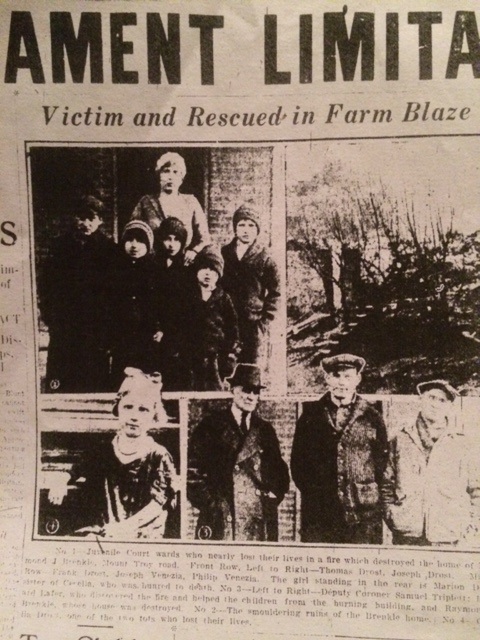
If I was shocked by seeing my grandpa on the front page of the newspaper, these two envelopes shocked me even more.

The picture at the top of the page is Phil (right) and Joe (left) the summer after they came to the farm. This is the youngest I have ever seen either boy. Unless I stumble on a trove of baby pictures by a forgotten Venezia relative, it maybe as young as I get.

I look at their faces and I can see that they are happy. It makes my heart soar. They look like they are having a terrific time. After all they’ve been through, they’re in the summer sunshine, together, with clothes and shoes. Grandpa looks a little silly. I’ve seen my brother make that same face when he’s being goofy and someone’s trying to take his picture.

PhilonthefarmThis next one is just Phil with another one of the farmhands. It might even be Howard Lager. I think it kind of looks like him.
These pictures make me think again — if you’ve got dozens of kids passing through your farm just to do work, why take their picture? Why treat them like members of the family if you were just going to cast them out when the season was over? That wasn’t going to be my grandfather’s and great-uncle’s fate, it seems.

Joe's weddingThis next one cracks me up. Joe, even though he was the baby brother, was the first Venezia boy to get married. In 1932, he married Ruth Broglie. Joe, looking almost like a movie star, is on the left. Phil, on the right, was his best man. Awwwww.

I laugh because my dad looks like that in a tux. He stands the same way, with his hand at his side, fingers curled almost the same way. They look so Godfather. I’m not sure who the little girl or the maid-of-honor are. I’m also shocked to see how much both boys look like their parents. Joe is Francesco with Saverina’s eyes and forehead smoothed over the sharp edges. Phil is his mother, with his father’s thin face pulling what could be too round into a squarish-oval. Two more generations, and my face is what my Grammy always admiringly called “the perfect oval.” I never thought so, but I guess that meant something back in the day. πŸ™‚

I’m full of good food and good memories now. I may not have concrete answers, but I have ideas. And as I think about writing the book, those ideas will surely guide my imagination.

The Stepfather

Since I discovered his existence, I’ve been curious about Mike Natale. I wondered about the man he was, what motivated him and, most importantly, what compelled him to walk away from three children who’d just lost their mother.

There are plenty of good men out there who step up to the plate and raise other people’s children — whether they’re uncles, stepfathers, grandfathers or good friends. Why was Mike Natale not among them?Β Heck, even Pasquale, such as he was, took his niece and nephews in.

I’ve found no indication that the siblings remained with Mike after their mother died. And if she was in the hospital for a month, it could be possible they were shipped to Pasquale’s before that.

Natale is a hard name to trace because there are many, many, many Natales. With a first name like Michele (Mike), it’s is even harder. I at least have his birthdate from the marriage record in 1916.

So, I do what so often ends up working for me. I Google and Ancestry until I come up with … something.

What I found tonight could offer an enormous explanation. Once again, it was a variation of the name (which you can set filters for on Ancestry) that brought up the hit.

If it’s true, it adds a whole new dimension to my grandfather’s brief life with his stepfather.

You see, the Mike Nataley I found, who was Italian, the correct age, was a widower and living in Allegheny County was, in 1920, living in an insane asylum.

If this is indeed the same man who for a year was Phil’s stepfather, it would go a long way to explaining why he didn’t, or perhaps couldn’t, take care of the siblings. It also creates a very sobering picture of what life might have been like for my grandfather in his home.

And it becomes even harder to judge “what kind of man” this stepfather was in light of this information. He could have been undone by grief and been dealing with a variant of depression. Mental illness was so incredibly misunderstood in this era people were locked up for things we treat successfully with talk therapy and medication today. He also truly could have had something very serious such as schizophrenia or bipolar disorder, which even today can require hospitalization. He could have been an addict. I don’t know. And what’s more, I don’t know if this Mike Natale(y) is our Mike.

So I’m Shoeboxing it until I find further supporting evidence.

And I’m left to wonder. Not just about Mike, but one of the perpetual questions of my search. What happened to Mike and Saverina’s baby?

Thankful for the Carnegie Library — Again

DispatchPhotoLook at this. Just look at it. I’ve had it in my possession for two days now and I can’t stop staring at it.

This is the first time I’ve seen my grandfather this young. And oh, what a picture it is. It was on the front page of the Pittsburgh Dispatch. It was taken the morning after the fire.

You may not be able to see it very well, but that’s Phil on the far left. Joe, Marion Drost and her brothers, are all standing in front of steps that go to the shell of the burned out house. I stare and stare at Grandpa’s face. In spite of the blur, I can see the despair in his eyes. His jaw is clenched.

Of all the material I found over the last 48 hours, this is the most amazing.

I knew the story was front-page, but a photo like that makes it so viscerally real to me. How many times have Jason and I been on the opposite side of the lens? I feel like I can see the scene going on all around the edges of this picture so clearly.

I won’t be able to link the material I found because I copied it all off microfiche and it doesn’t look like any of the other papers were part of the Google News Archive project. I’ll just have to summarize.

Pittsburgh had half a dozen major newspapers that covered the area. How they approached the story depended on their proximity and, to be honest, objectivity. Some, like the Press and the Gazette, were pretty straightforward. The Dispatch, News Chronicle and Sun, along with a few others, were a more lurid in their coverage. And one paper, I forget which one, got so much wrong in the initial report that I was glad the reporter’s name wasn’t memorialized. I’d have been mortified.

But all that helped me get a much clearer picture of what happened that night because certain facts are consistent throughout the reporting.

They include:

  • Howard Lager being on the phone with a woman who was not his wife at about midnight on the night of the fire (he was married at the time, but his wife and child were living elsewhere.)
  • Howard sounding the alarm that roused the house
  • Howard waking Phil first and the two of them fighting the fire in the kitchen together with pitchers.(This fact just wrenched my heart. He must have been terrified. The fact he escaped out the kitchen window made it all the more harrowing.)
  • Howard going back upstairs through the flames to rescue his niece and nephew (Anna Mae and Buddy). He saved them and himself by tossing the kids down to Raymond and then climbing down a porch support.
  • A central furnace had just been installed in the house. Howard recalled the vents on the floor were hot as he passed over them and there was an odor of “varnish” in the air near them.
  • Phil and Joe corroborating Howard’s statement of the night’s events when on the stand during the inquest.

There were also some very interesting revelations:

  • The Brenckles had homemade wine and were drinking it that evening. This was during the height of Prohibition. Homemade wine was allowed, but of course anyone who drank was vilified.Oopsie.
  • There was a fight on the evening before the fire between Myrtle, Howard and Cecilia over a ring. Howard had apparently given it to Cecilia (uh…). Myrtle was flipping out over it. Cecilia returned the ring that evening.
  • No one saw Cecilia after she went upstairs to bed. She never made it out of the house.
  • There was confusion among the fire companies over who covered the fire. The property is between Reserve and Ross. The call to their version of 911 went into the city first. There was a significant delay in getting help out to the house.
  • John Orlowski may have gone back into the house because he wanted to rescue his dog. I can’t even think about how sad that is right now.
  • The Coroner was really, really hard on Raymond Brenckle. He all but accused the Brenckles of letting the kids burn while they worried about their own family.
  • The county’s Juvenile Court System was on trial, too. A number of the papers made some pretty good hay out of renting kids out for farmwork. The county paid about $5 a week for their care. When the trial concluded without an indictment, there were lots of speeches and pronouncements about how the District Attorney and President Judge would keep investigating, demanding answers. Yadda. Yadda. Yadda. I’ve sat now about 60 hours in front of mircrofiche and intranet search. I don’t see a scintilla of follow-up on this case. At least, until the next tragedy.

I’m in Pittsburgh to celebrate Thanksgiving with Mary Ann, Mike and my cousins, so it’s been incredible sharing these revelations with them. And I’m feeling even more thankful that none of us ever had to live through something like this.

Blog at WordPress.com.

Up ↑