Search

findingphilblog

In search of my grandfather's past … and maybe a book deal

Category

Research tools

Watching the Italians

iaLandscape

I can’t speak highly enough of this incredible series. PBS always does a fabulous job with documentaries, but ‘The Italian Americans’ is superb. I’m only two hours in, but I am already wishing for the next installment.

I loved hearing about the “birds of passage,” stories which filled in more deeply my notions of the trips Pasquale, Cesare and possibly Ottavio took from the U.S. to Italy.

It also clearly articulates the harsh conditions Francesco Venezia likely left in Italy and the different set of challenges he faced once he arrived. In all the reading I’d done in preparation to write my book, I’d come across all kinds of things that made my jaw drop.

Full-page ads from the Sons of Italy saying “We’re Americans, we love this country!” during the height of both World Wars. Descriptions in newspaper articles that we would today call blatantly racist. That, taken with the information presented in the series, made me realize that what I am so proud of today would have made me an outcast a century ago.

There is so much that my grandfather likely protected my father from. From Phil’s memories of a broken childhood and the possible violence that may have been a part of it. From the taunts and slurs Phil probably endured, possibly into adulthood. Not everyone manages to do that, to keep the bad stuff back and in the past. It makes me respect him, and my ancestors, even more.

The Results are In

EthnicityCapture

My DNA test results are in (cue the Maury Povich music).

Actually, they came back a few weeks ago. The fact I’m posting now should tell you they were fairly unremarkable.

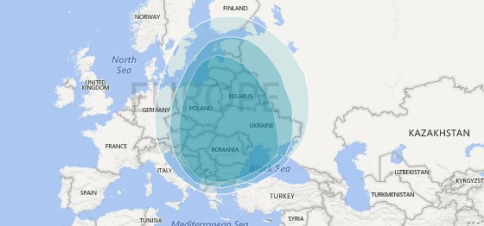
I knew my background regions all along. So, no surprises there. But what did shock me was how little of my DNA seems to come from Italy.

My profile states that I am 51 percent Western European, 24 percent Eastern European, 11 percent Great Britain and only 8 percent Italian. Whaaaat??? My grandpa was 100 percent Italian, as in, both his parents came from Italy and I’ve traced their roots very far back.

My grandmother was 100 percent Slovak. My other grandparents were 100 percent Polish and 98 percent Irish, with a little French Canadian thrown in because the Irish branch emigrated through Canada rather than the US.

I was expecting more Italian. But, ah, perhaps ol’ Fillipo Aristodemo had some other types of blood running through his veins!

I suppose it depended on what was in my spit that morning I took the test. Maybe the Italian portions were still sleeping.

I do take a lot of comfort in knowing that the majority of “me” is made up of the DNA most closely associated with my wonderful Grammy and my equally gentle, loving and kind Grandpa Krajenke (the Polish portion, if you couldn’t tell.)

I’ve been thinking a lot about how comforting this notion of inheritance is, at least for me and in my circumstance.

My mother-in-law, you see, is not doing well. She’s in the end stages of a progressive and ultimately fatal disease. My daughter, despite visiting her every week along with her Daddy, will only know her in pictures. However, there is a portion of her that will always be with her, that will always be with Jason, too.

My mother and father will be with me and with my daughter long after they are gone. A part of me will be with my daughter until the end of her days.

So, that means Grammy, and yes, Phil, are with me right now.

In physics, you learn that matter is neither created nor destroyed. With this test, it shows that is indeed the case. Lives echo on and on, catching the shore of the present day like the tide.

News from Pittsburgh

PasqualeDCCaptureThis was in the Pittsburgh Post-Gazette a few days ago.

I, of course, was intrigued by the appearance of Woodville, as that is the hospital where Pasquale died.

There’s a lot of political feeling around institutionalization, so we’re not debating that here. But what is sad is as these facilities are closed, there are many graves that are abandoned.

One never knows when the family history bug will bite, but one of the hardest things to hear as you research is “Oh! If you had come X years or months or days ago. We just threw it out/it got torn up/the place got demolished.” You kick yourself endlessly for not getting started sooner.

I reached out Sam Sirabella, the man mentioned in the article as possibly having information about Woodville. He did a record search for me and couldn’t find anything on Pasquale Brescia. As Father DeVille notes in the article, the site contains 1,064 graves. My great-uncle is very likely among them.

The article reminds me that I haven’t looked for Pasquale among the newly released PA death records. It doesn’t take me long to find him. There’s not much that I don’t already know here. I’ve got lots of other records confirming much of what’s there. But there are a few nuggets, the largest of which is that whomever wrote out this death certificate seemed much more inclined to accuracy. It now appears that Pasquale, Ottavio, Saverina and Cesare’s father was named Cesare Brescia. Their mother was Fillipina Oliva. Now there is consistency among the records for at least these two siblings. I feel comfortable updating my tree with the new information.

I also note there is a discrepancy of a day on Pasquale’s death date between the death certificate and the documents that left his money to the Venezia siblings and his brother Ottavio. I’m going to go with this record, since it the official state record.

I’m thinking the next time I head to Pittsburgh, I’ll see if my cousin Bryce, who was involved in a ghost-hunting group that explored Dixmont before it was torn down, wants to go for a visit. His group was featured on Scariest Places on Earth on ABC Family a few years back. Here’s his episode of if you want to check it out!

The 1940 Census is here!!

Census1940In business-ese, digging into something and spending a lot of time with it has a jargon-y phrase: taking a deep dive.

Well, I’ve been scuba-diving in the 1940 Census since it was released a few days ago.

It’s not exactly relevant to my writing project. It’s more like a roadmap for what happens next. If writing is about building a story arc, then these bits of information might help me craft scenes that allude to something that may not happen for a decade, but still matter. And besides, if I see where they go, it will help me stitch together the path of how they got there.

Of course I had to look up Grandpa first. What I found is interesting. He’d moved out on his own. He was listed as a lodger at a boarding house on Lockhart Street. It doesn’t exist anymore. The street dead-ends under bridge on the North Shore. It’s interesting that Grandpa’s noted as having zero education. I’d always heard he’d never gotten beyond 8th grade. But it looks like the census man spoke with him directly. Hmm. I was happy to see he worked all year in 1939 as a “produce man” (I suppose that could be an abbreviation for manager or it could just be produce man). But that he’d made only $1000 for all his effort. It sounds abominable, but in reality, it was on the lower end of middle class. I figure he had a lifestyle very similar to the one I had when I was single and working for my first newspaper. You were OK, but you really hoped no big bills or unexpected circumstances hit.

I wonder how he felt, living alone. I know that when I shut the door on the first day of living in my first apartment, I was so excited to be in charge of everything. Seems crazy now, of course. Haha. But I wonder how a guy, who’d spent his entire life making sure his family stayed together, felt to finally have a little bit of space for himself. His little brother was married. His sister was being taken care of at the Fresh Air Home. Maybe he just relaxed a little. I hope he had some fun. I hope he went out at night, had girlfriends and found something interesting to do in his spare time. Maybe that’s when he learned to play the concertina!

As we know, Joe and Ruth got married in 1932, so they were out of the Brenckles house, too. They lived in the rear of Ruth’s mother’s house. They had been living there at least five years, too. Joe is a laborer in Retail Food. I’m not sure if that means he’s slinging produce boxes at Donahoe’s with Phil, if he’s working for the Brenckles’ stand or something else.

I also looked up Marion, to see if she was still hanging on. She was. She was still in her house on Ruby Way, but with one more kid. And her brothers were still living with her, although it seems that this person who’s doing the correcting to their posts has made the boys Stephen’s brothers. Their names are also misspelled, but misspelled in the same way they were a few times in the fire coverage. Grost. In fact, the cursive D looks like a G, so the Ancestry algorithm could just be picking up the variation.

Either way, by the eve of World War II, it looks as if everyone had put the events of the past behind them. They were, after all, a solid 17 years behind. For grandpa, it was actually pretty significant. He was 16 when it happened. He was now moving into a future where he was a full lifetime removed from all the troubles of his childhood.

When I think about Phil’s life, sometimes I think of Andy Dufresne from the ‘Shawshank Redemption’ and the line in the movie, as Andy’s escaping: *Morgan Freeman voice* “Andy Dufresne, who crawled through a river of shit and came out clean on the other side…’

That’s about right.

Look who’s back, back again

Yeah, I kinda flaked for a year there on my postings.

To be honest, my research shut down as I conducted two more vital ones. The search for a new job (my choice, don’t worry!) and a new house (because it was time).

I’m happy to report that both were successful. I’ve got a new gig in Corporate America where I will continue to write, but in a different format and style. And Jason and I, after three years, finally found a place to call our own. Thanksgiving 2010 was spent binge-researching at the Carnegie Library. Thanksgiving 2011 found me elbow deep in paint and spackle.

But now that things have finally calmed down at work and on the homefront, I’ve gone back to my evenings in front of the TV, where I “Play along at home” as I watch ‘Who Do You Think You Are?’ The first episode of the season was Friday (Martin Sheen) and I dug into the website after the show.

Saturday’s mission was seeing if I could find out what happened to the Drost kids. Marion, Frank, Thomas and Joseph survived the fire just as Phil and Joe did. Surely, they had scars from that ordeal, and likely more deeply because they lost their sister. Phil, miraculously, kept his sibling.

So, I started poking around. I found the family easily enough in the 1910 Census. Their father was also Frank. And he was an iceman in this family snapshot. Interestingly enough, there is the children’s mother, Teresa. The family appears to be of Polish-German origin, which means over the next two censuses, their national identity will change at least twice as the boarders shift due to war.

But a decade later, Teresa is gone. Frank, as the papers had said, was a police officer for the city. Interesting. I look up at the date on the census. It was recording literally the month before his children became wards of the Allegheny County Juvenile Court. A policeman. With four kids in county care. That alone would be front-page news today.

It’s hard to find big Frank, but by 1930, I think I may have found Marion and little Frank, along with Thomas.

If it is the same family, Marion is now Mrs. Marion Baker, with a young son named Paul who is almost 3 (quick math, NO he is not Howard Lager’s). Frank Drost and Thomas Drost (correct ages) are living with them and recorded as being brothers of the head of household, a title Marion and her husband Stephen seem to share. He’s recorded as Head, but there’s an H next to her name.

Again, though, I can’t be 100 percent sure because someone has used the feature Ancestry gives you to allow corrections to historic documents. I could have made one, for instance, when I saw how badly Pasquale’s name was misspelled in the 1920 Census.The corrected name is something else entirely, which holds me back from believing this is the outcome for Marion and her siblings.

I hope it is. Because that would mean that she at least (I hope) found peace and a home of her own. Her husband is a steelworker, and if Stephen’s personal history held to the wider arc, that would mean the family probably found a solid, middle-class life. And, just like Phil, she managed to keep her immediate family together.
The Stepfather

Since I discovered his existence, I’ve been curious about Mike Natale. I wondered about the man he was, what motivated him and, most importantly, what compelled him to walk away from three children who’d just lost their mother.

There are plenty of good men out there who step up to the plate and raise other people’s children — whether they’re uncles, stepfathers, grandfathers or good friends. Why was Mike Natale not among them? Heck, even Pasquale, such as he was, took his niece and nephews in.

I’ve found no indication that the siblings remained with Mike after their mother died. And if she was in the hospital for a month, it could be possible they were shipped to Pasquale’s before that.

Natale is a hard name to trace because there are many, many, many Natales. With a first name like Michele (Mike), it’s is even harder. I at least have his birthdate from the marriage record in 1916.

So, I do what so often ends up working for me. I Google and Ancestry until I come up with … something.

What I found tonight could offer an enormous explanation. Once again, it was a variation of the name (which you can set filters for on Ancestry) that brought up the hit.

If it’s true, it adds a whole new dimension to my grandfather’s brief life with his stepfather.

You see, the Mike Nataley I found, who was Italian, the correct age, was a widower and living in Allegheny County was, in 1920, living in an insane asylum.

If this is indeed the same man who for a year was Phil’s stepfather, it would go a long way to explaining why he didn’t, or perhaps couldn’t, take care of the siblings. It also creates a very sobering picture of what life might have been like for my grandfather in his home.

And it becomes even harder to judge “what kind of man” this stepfather was in light of this information. He could have been undone by grief and been dealing with a variant of depression. Mental illness was so incredibly misunderstood in this era people were locked up for things we treat successfully with talk therapy and medication today. He also truly could have had something very serious such as schizophrenia or bipolar disorder, which even today can require hospitalization. He could have been an addict. I don’t know. And what’s more, I don’t know if this Mike Natale(y) is our Mike.

So I’m Shoeboxing it until I find further supporting evidence.

And I’m left to wonder. Not just about Mike, but one of the perpetual questions of my search. What happened to Mike and Saverina’s baby?

Thankful for the Carnegie Library — Again

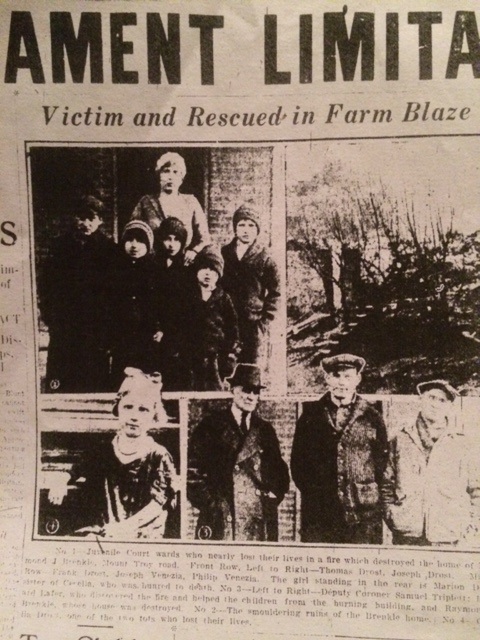
DispatchPhotoLook at this. Just look at it. I’ve had it in my possession for two days now and I can’t stop staring at it.

This is the first time I’ve seen my grandfather this young. And oh, what a picture it is. It was on the front page of the Pittsburgh Dispatch. It was taken the morning after the fire.

You may not be able to see it very well, but that’s Phil on the far left. Joe, Marion Drost and her brothers, are all standing in front of steps that go to the shell of the burned out house. I stare and stare at Grandpa’s face. In spite of the blur, I can see the despair in his eyes. His jaw is clenched.

Of all the material I found over the last 48 hours, this is the most amazing.

I knew the story was front-page, but a photo like that makes it so viscerally real to me. How many times have Jason and I been on the opposite side of the lens? I feel like I can see the scene going on all around the edges of this picture so clearly.

I won’t be able to link the material I found because I copied it all off microfiche and it doesn’t look like any of the other papers were part of the Google News Archive project. I’ll just have to summarize.

Pittsburgh had half a dozen major newspapers that covered the area. How they approached the story depended on their proximity and, to be honest, objectivity. Some, like the Press and the Gazette, were pretty straightforward. The Dispatch, News Chronicle and Sun, along with a few others, were a more lurid in their coverage. And one paper, I forget which one, got so much wrong in the initial report that I was glad the reporter’s name wasn’t memorialized. I’d have been mortified.

But all that helped me get a much clearer picture of what happened that night because certain facts are consistent throughout the reporting.

They include:

  • Howard Lager being on the phone with a woman who was not his wife at about midnight on the night of the fire (he was married at the time, but his wife and child were living elsewhere.)
  • Howard sounding the alarm that roused the house
  • Howard waking Phil first and the two of them fighting the fire in the kitchen together with pitchers.(This fact just wrenched my heart. He must have been terrified. The fact he escaped out the kitchen window made it all the more harrowing.)
  • Howard going back upstairs through the flames to rescue his niece and nephew (Anna Mae and Buddy). He saved them and himself by tossing the kids down to Raymond and then climbing down a porch support.
  • A central furnace had just been installed in the house. Howard recalled the vents on the floor were hot as he passed over them and there was an odor of “varnish” in the air near them.
  • Phil and Joe corroborating Howard’s statement of the night’s events when on the stand during the inquest.

There were also some very interesting revelations:

  • The Brenckles had homemade wine and were drinking it that evening. This was during the height of Prohibition. Homemade wine was allowed, but of course anyone who drank was vilified.Oopsie.
  • There was a fight on the evening before the fire between Myrtle, Howard and Cecilia over a ring. Howard had apparently given it to Cecilia (uh…). Myrtle was flipping out over it. Cecilia returned the ring that evening.
  • No one saw Cecilia after she went upstairs to bed. She never made it out of the house.
  • There was confusion among the fire companies over who covered the fire. The property is between Reserve and Ross. The call to their version of 911 went into the city first. There was a significant delay in getting help out to the house.
  • John Orlowski may have gone back into the house because he wanted to rescue his dog. I can’t even think about how sad that is right now.
  • The Coroner was really, really hard on Raymond Brenckle. He all but accused the Brenckles of letting the kids burn while they worried about their own family.
  • The county’s Juvenile Court System was on trial, too. A number of the papers made some pretty good hay out of renting kids out for farmwork. The county paid about $5 a week for their care. When the trial concluded without an indictment, there were lots of speeches and pronouncements about how the District Attorney and President Judge would keep investigating, demanding answers. Yadda. Yadda. Yadda. I’ve sat now about 60 hours in front of mircrofiche and intranet search. I don’t see a scintilla of follow-up on this case. At least, until the next tragedy.

I’m in Pittsburgh to celebrate Thanksgiving with Mary Ann, Mike and my cousins, so it’s been incredible sharing these revelations with them. And I’m feeling even more thankful that none of us ever had to live through something like this.

In which I hit the information motherlode

SorboAll I can say is I freakin’ LOVE you, Ancestry!!
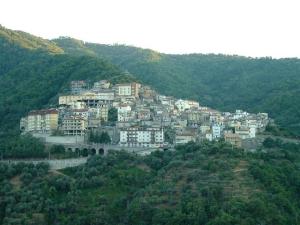
In the intervening months, I also circled in on the exact town where we are from. Sorbo San Basile. I cracked up when I found out they had their own website. There were pictures of people at local festivals and daggoneit if every single person didn’t look somewhat like me and my dad. Here’s the site.

It’s a speck on the map, really. So, if Catanzaro Province is like Pennsylvania and Catanzaro the city is like Harrisburg, then Sorbo San Basile is like Newburg. Someone from Newburg isn’t truly from Harrisburg. And when you start talking researching records, you’ve got to be specific.

Ancestry has message boards where you can post questions to see if you can connect. Well, I figure I might as well get on the Italy boards and see what’s what. There’s actually a forum for people searching Catanzaro, so I post there with Francesco and Saverina’s information.

I wait awhile and get a few responses. Then one guy tells me I need to check out a woman by the name of Dina. She’s apparently the person I want to connect with.

When we finally do connect, she combs through her extensive catalog of research and comes up with gold. This is our town, all right, and we go back a long way.

The name Venezia is not a “real” last name, per se. Italians would give orphaned babies the last name Esposito (meaning exposed. aw.) or the name of a large city in Italy. Based on the records in her tree, Francesco’s father Filippo Aristodemo Esposito Venezia (that’s a mouthful), was an orphan.

And get this. In the old days, churches in Italy had these things called “ruta.” They were little wheels that were in the exterior walls. There was a basket on the wheel. You can probably see where this is going. People put babies in the basket, turned the wheel so the baby was inside, rang a bell and ran. The nuns and priests took in the child.

It’s crazy how history repeats itself. Filippo was an orphan. Phil, who was likely named for his grandfather in the traditional Italian way, was an orphan. I realize that if my dad lives to see his grandchildren, he will be the first Venezia man in more than 100 years to do so. But, you know, no pressure. 🙂

That’s Francesco’s father. But it turns out Filippo Aristodemo married pretty well. Maria Giuseppa Gagliardi was from Sorbo’s upper class.  The men in her family, Dina said, would have had the honorific Don Gagliardi, meaning landowner. OK, so it’s no castle in Italy, but it’s still pretty cool.

In hooking my tree up to Dina’s, I’ve discovered lines that go all the way back to the 1500s. I’ll probably never know exactly what we were before Venezia, but I’m still pretty proud to claim them. Dina’s not found much of anything on Severina, so there’s still that angle to pursue.

In the meantime, I’m savoring the thrill of truly, finally finding home for my dad and our family.

What we learned at the inquest

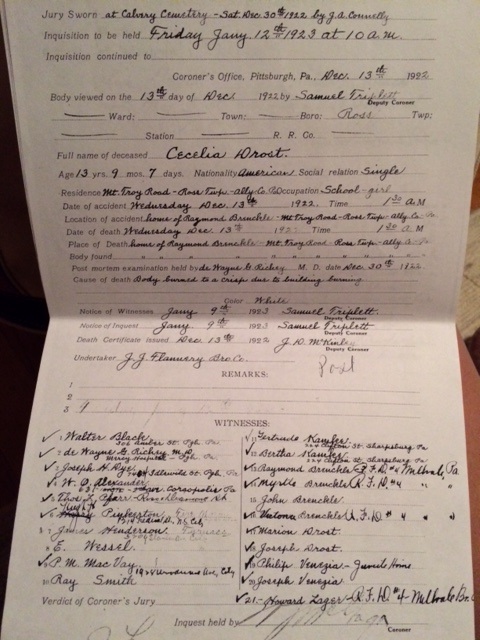
CeciliaPressReportThe Coroner’s Inquest has arrived and it left me feeling a little empty. There was some good stuff, for sure, but what was missing was the transcript. Surely, somewhere in the bowels of the Allegheny County archives, there must the record of what was said during the hearing over whether the fire was intentionally set.

Don’t get me wrong, I’m really happy to have it. It’s part of my general research on the case itself and it fills in a few details.

** WARNING: GRUESOME DISCUSSION AHEAD.**

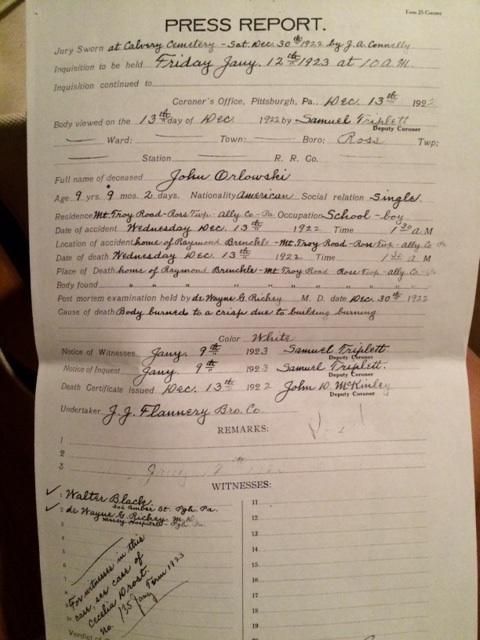
So, anyway, the details of the kids’ deaths are pretty horrible. And the autopsy records are the stuff of nightmares.They were incinerated virtually beyond recognition. All that was left of poor Cecilia was the middle of her body. Poor little John was a head, upper torso and part of a femur. What’s interesting, and frankly odd, is that the coroner DUG UP THE BODIES to autopsy them. Uh, wait. What? Doesn’t a coroner hold a body and then release it for burial after a cause of death is decided? The bodies were buried shortly after Dec. 13th. The autopsy was conducted on the 30th. Both autopsy reports note the putrid odor of the remains.

I missed that little, about the hasty burial, when I read that article about the funeral services. I’d presumed the autopsy had been performed before the burial.

JohnOrlowskiPressReportAll that was left of both children was bones wrapped in a tarp. My heart broke for them. And for their parents. Yes, parents. In re-reading that funeral article, I also saw that the Drost kids father was still alive, as was John Orlowski’s father. Both are mentioned as having either attended the service or were being sought for contact. Phil and Joe were the only “true” orphans in this equation.

It was interesting to see that the Coroner’s office provided a Press Report, which contained the verdict, all the witnesses and general information about the deceased.

There was also a Proof of Identity document for Cecilia and John. Each contains critical information, such as when they were remanded to care and when they came to live at the Brenckles. I note that Camilla Barr, whose name appears in conjunction with Mary Venezia’s petition to have South Side Trust named as guardian of the money Pasquale left her, was the person in charge of Cecilia.

The cause of death, obviously, was incineration. Nothing further could be determined by the remains, including the sex of each body, according to the doctor who performed the autopsy — DeWayne Ritchey of Mercy Hospital. That fact was probably what made it hard for the jury to indict Howard Lager.

** OK TO RESUME READING IF YOU SKIPPED THE LAST PART **

Another interesting find was that Walter Black was indeed the person who oversaw the cases of all the children at the Brenckles. So, he was Phil and Joe’s caseworker. Interesting that the head of the department was the person overseeing them.

The documents also show that John had come to the farm roughly the same time as the Drosts. All things being equal, I’m going to go ahead and just figure Phil and Joe did as well. It looks as if the Brenckles were purposefully taking in sibling groups. Some people may quibble with me on this, but I think it’s at least a little kind-hearted. It’s pretty meaningful for kids who face the kinds of trauma all of them faced to have their siblings.

But what I really need is that transcript! If I’m going to really find the truth, I’m going to have to know exactly what was said by whom and when. I think my next stop is probably the State Archives.

Blog at WordPress.com.

Up ↑