Search

findingphilblog

In search of my grandfather's past … and maybe a book deal

Category

Uncategorized

Hold my Hand

I woke up smiling, because I never expected to meet him there.

My Grandpa Phil died 14 years before I was born. Unlike my Grammy Helen, Grandpa and Grandma Krajenke, he and I had no shared experiences that might cause my sleeping subconscious to toss up a memory disguised as a dream.

Which makes what happened last night all the more magical.

I love all my grandparents. In the years since their passing, I’ve met them again in the oddest, but always joyous, moments. An unexpected whiff of Opium perfume that appeared from nowhere (Hi, Doris!); a crystal-clear, post-meditation vision of my tanned, grinning Grandpa Richard, waving from a swimming pool; Grammy sending me pennies in unexpected places and dream notes. Even my excellent Uncle Rick, who died too early in 2007, nudged me over the radio with a song by his beloved Beatles on or near the anniversary of his passing. But over the 20 years of working on “Three Rivers Home,” I’d come to understand that Grandpa Phil likely wouldn’t appear in my dreamscapes because he’d been sadly absent from my childhood.

Until last night, which coincidentally happened to be the 103rd year since the morning he awoke to the horrors of the Brenckle Farm Fire.

It was the first time, ever, that I dreamed of Grandpa Phil. In that distant kingdom, he was hale, hearty, and healthy. I’ve never heard his voice, but when he spoke, I was sure it was true — Pittsburghese, tinged with an Italian-American childhood. I don’t remember much, other than being so excited to see him. We were in the Pittsburgh of today, a modern world of autonomous vehicles on Grant Street and the PPG building ascending, in all its chrome-shining glory, to the sky. The city, compressed in that dream-like way, made the Kaufmann’s Clock intersection across the street from PPG Place.

More than anything, I wanted to bring him home, to the house he built, where, in my dream, I knew my cousins, brother, mom, dad and aunt waited with Grammy. “Let’s tell her!” the dream me said. “She’s going to be so excited.”

And then, as we prepared to cross the street, he took my hand. My last thought before waking was, “I can’t believe it! I’m holding Grandpa’s hand.”

I awoke. It was 3 a.m. I chuckled softly in the darkness, exhaling the surprised thrill I’d drawn in the dream.

This, like the Christmas letters, the photo or the dozens of little twinkling outposts of hope along the way, serves as a sign — to me, anyway — that those we love never truly leave us, even if that love transcends mortality.

I will get back up again

IMG_8046

When you live in a house with two artists, crazy ideas routinely unfurl. That’s when one of us turns to the other and shrugs: “You can’t wrestle if you don’t weigh in.”

Well, after almost 13 years of research and five years of writing, it was time. Heart in my throat and Hamilton‘s “My Shot” roaring in my ears, I took Grandpa’s story to the annual Pennwriters convention. It was, in all places, Pittsburgh. On the same weekend I’d already booked an Italian genealogy course at Heinz History Center. A course led by — gasp — a man named Rich Venezia (who was wonderful and, sadly, no relation.) Surely, fate was on my side.

And it seemed, for a moment, like it was. I pitched two agents. Both enthusiastically asked for pages. A lot of them. This was it, I thought. All those years of work, and I’ll bang it out the same way I did Jeopardy! — nailing the audition on the very first try.

To quote the marvelous Julia Sweeney — God said Ha.

A pitch, a swing and a miss. The first agent said no thanks. The concept was fascinating. There was the little problem, however, of not having developed it well enough. She was sweet and wonderful and absolutely professional in every way. She invited me to re-pitch if I reworked it. This is more than generous.

The two-page critique at the conference, and then a critique group a month later all coalesced to a single truth: I was not as ready as I thought. I’m not going to reach out to the second agent until I am.

Oddly enough, it was Jillian who convinced me not to. When I told her things hadn’t worked out, I asked her “What do you think, baby? Should mommy send her story, or wait and make it better.”

With guileless eyes, she stared into my soul and said “make it better, Mommy.” Who can argue with that? Plus, if this adventure taught me anything, it’s that slowing down can sometimes make everything move faster a bit later. So, now it’s time to take my time — something that is never easy.

Speaking of easy, Jason likes to remind me of another truth. If it was easy, everyone would do it.

So instead of reaching Everest, I’ve tumbled all the way back to the Kathmandu airport, pack in hand, wondering if I’m nuts to even try such a thing.

So, I do what I always do. I buy more books.

Fix Your Story. The 2019 Writer’s Market. Pull out the books on self-editing I borrowed from Valerie years ago. Because I made the cardinal mistake many new, aspiring authors do — thinking that a great true story and mastery of other styles translates to literary success. It very, very rarely does. Like letting go of all my journalism hang-ups so I could learn to write for business, I’m reaching for a new editorial horizon. 

Sometimes, the questions seem insurmountable. I could take the story this way. Or that. What is right? No one can tell me. It is trial and error upon error upon error. It is not for the faint of heart.

But my heart’s pretty good. It stands in the place of Phil’s broken one.

At the very least, I’m always telling Jillian it’s the effort that matters. In the words of one her favorite songs (from the movie Trolls) “if you knock/knock/me over/I will get back up again.” What’s true for a five-year-old is surely true for her 41-year-old mom, right?

A peek into the past

Still writing, still revising. But in the meantime, the Pittsburgh Post-Gazette has given me a beautiful gift — a glimpse inside the now-abandoned Our Lady Help of Christians. It’s sad to see something that was such a vital part of the community come to ruin like that. But the photography here shows how grand the church must have been. It’s even easier to imagine, now, what it was like when my great-grandparents walked under those arches. How my grandfather and his siblings must have strained their necks to look at the stained glass windows or follow the shadow of the sun across the pillars.

Confronting Ohio

I stepped out of the car, closed my eyes and breathed deep. I was finally here, in a place I had no idea I needed to be.

The Christmas letters had proved conclusively that Phil and Joe spent time living with their uncle, Ottavio Brescia, in Bellaire. It was only for nine months, and not only did they not look back, they erased their uncle and the town from their existence.

So, there I stood, a Venezia renamed and returned to discover whether the contours of the brief, sad life Phil and Joe lived here were still visible after almost 100 years.

The answer was yes and no.

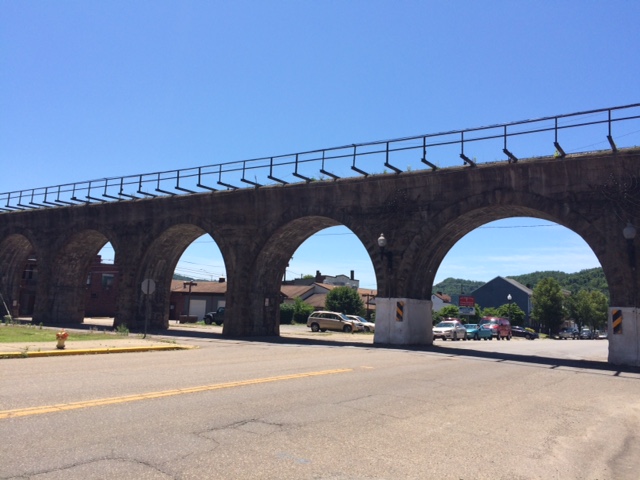
Buildings remain. The old bank, which was still under construction in the summer of 1923, towers eight stories over the downtown landscape. The soot-stained viaduct sits sentinel, dividing the town from its outskirts, but has long fallen into disuse. The massive Imperial Glass factory that employed half the town is two decades gone, replaced by a shopping center. The house IMG_2510where Phil and Joe lived with their uncle — just across the street from the factory — is gone as well.

Bellaire itself seems a bit sad, in the way that all small towns that have lost their economic heartbeat are. I know from my research that there are committed groups of citizens working to make it better for the 4,000-plus souls who still call it home. You can see it in the splashes of fresh paint and newly-made signs interspersed among the boarded-up storefronts.

I said it’s been just under 100 years since a Venezia set foot here, but the Brescias never left. And so, a walking dichotomy, I set off in search of the past. I begin at the Bellaire Public Library.

Ottavio had a life after the boys. The Census from 1930 shows him as the proprietor of his own grocery store. The father of two young sons married for many years. In quick succession, I discover his boys grew up here and had families of their own. Father and both sons are buried in the cemetery nearby. I comb through microfiche, hoping for photos.

I discover one of Ottavio’s sons, John. He would be my dad’s first cousin, once removed. One look and I am reassured that the Brescias I’ve chased here are the right ones. From Severina through to me — it’s the eyes and that chin!

Excited, I spill the Cliff Notes version of the story to the librarians. With equal fervor, they dip back into their own memories to tell me that John was known as “Bushy” and worked the toll bridge. Chester, who died young (50) had a snack food business. And they remember Ottavio selling groceries up at his little store on the hill. The house is still there, they said. It’s being gutted and rebuilt as another Bellaire landmark – The House that Jack Built. One of them went to school with John’s daughter. I peer curiously at her yearbook photo and wonder at the outline of our shared history staring back.

When I hit the tiny branch library’s limit of resources, I wander around the town, eventually landing at the Imperial Glass Museum. A sweet couple with honey-dipped Southern accents leads me through the small rooms filled with display cases. I tell them about the letter Grandpa wrote back to Mrs. Brenckle, detailing his work at an unnamed factory, and they promise to pour through their old ledgers to see if he’s listed. I can’t resist buying a candy dish — Washington/Mount Vernon pattern. It would have been made during the year Grandpa was here.

Jason, playing devil’s advocate, likes to remind me that perhaps my sainted Grandpa and his brother were little twerps, mouthy and ungrateful as teenage boys can be. That maybe they were the lazy ones, refusing to do a man’s work and still wanting to run around like little boys.

I wonder, too. Absent people are always the easiest to love. You have nothing to go on but expectation and supposition; it’s a relationship uncomplicated by human interaction.

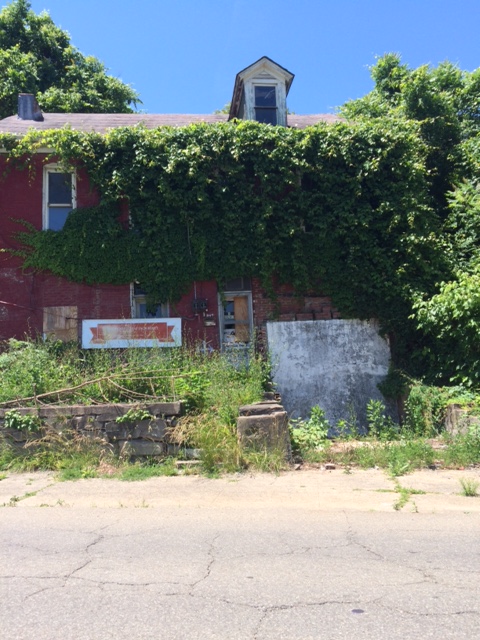
IMG_2513.JPGI take a drive by the Hamilton Street house Ottavio called home for many years. I linger just long enough to snap a picture from the air-conditioned comfort of my SUV. I grin at the absurdity of scrawny, beat-up Phil’s granddaughter rolling through town in a shiny black car, pointing her pocket computer at a crumbling monument to the past.
As I roll back toward Pennsylvania, I take stock of my expedition. I’ve had hit richer veins of primary source material. Emotionally, however, I hit the mother lode. I found kindness, helpfulness and the neighborliness only a small town can bring. From Phil’s letters, I know he, too, found patches of beauty among the ruin. That’s real. That’s the best I can ask for.

Research impediment 

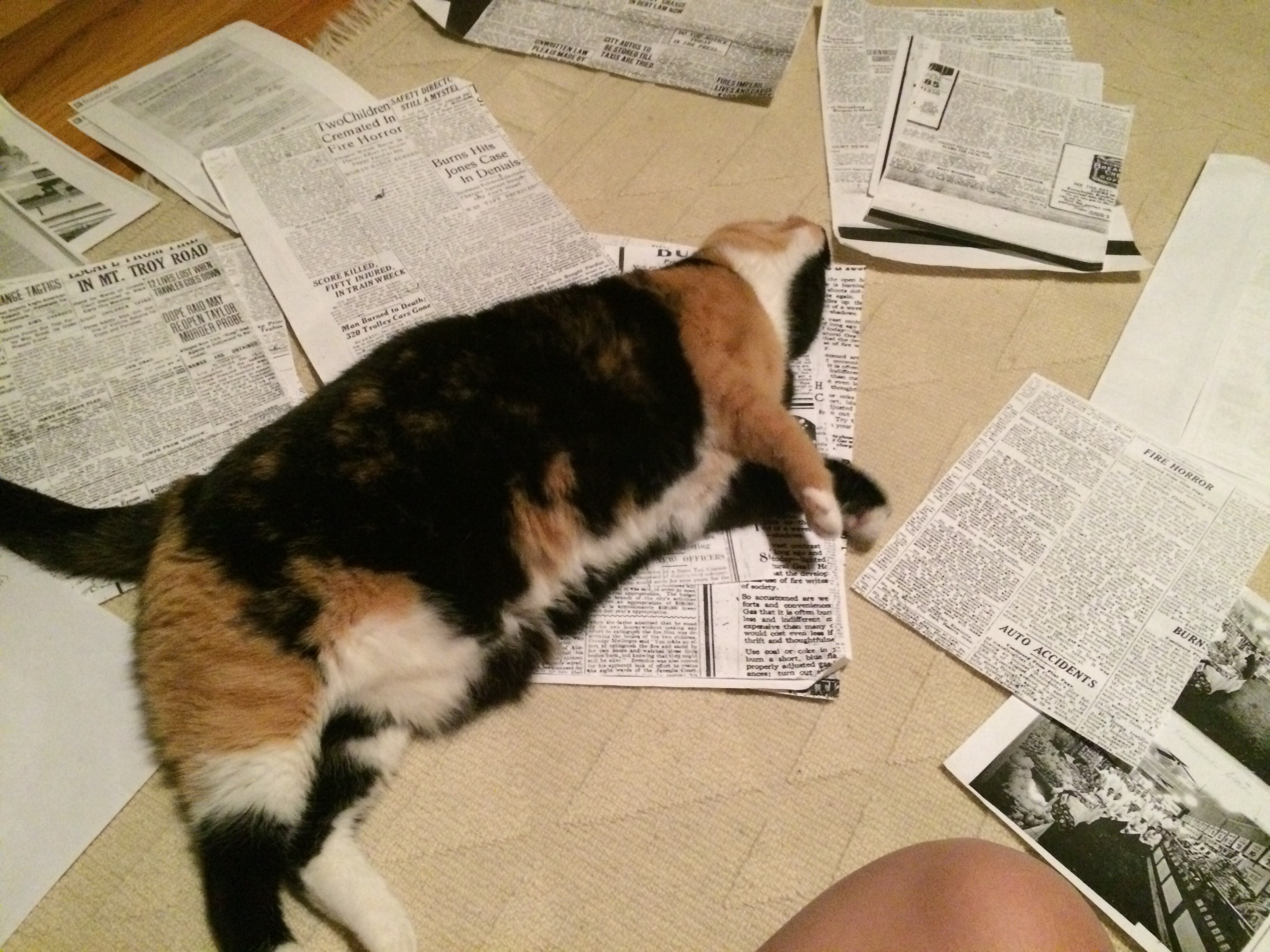
Miss Kitty sez: why u re-research this stuff? U been reading these articles for years! Why ur book no done?   

The greatest gift

It was the last thing we opened.

Cast carelessly next to our fireplace, it was tied with a simple red and white ribbon. The pair of scrapbooks had nearly been overlooked; but then I picked them up.

“What’s this?” I asked.

My Aunt Mary Ann stood up.

“I have to tell you the story,” she began. Hasn’t it always, in the 10 years of this quest to uncover my Grandpa Phil’s life, begun that way?

A few months ago, Nancy, Anna Mae’s oldest daughter, was cleaning out her home in Hatfield. Nancy was our host at the summer gathering that reunited the Brenckle and Brenckle/Venezia branches all those years ago. As she dug through her attic, she uncovered a packet of letters.

They were letters from my Grandpa Phil, and letters addressed to him. There were letters from Aunt Mary to her brothers.

They were, Mary Ann said, the answer to so many mysteries.

Thousands of hours of research could have never uncovered what was hiding in Nancy’s attic all these years. And now here they were — in the two purple-covered scrapbooks. They were mine (and my dad’s) because, well, they just had to come back home.

As Mary Ann unspooled her tale, I stared — open-mouthed and wide-eyed. I hadn’t realized how hard I’d hugged the books until I saw the groves in my arms. All I knew was that I felt, for a minute, as if I was hugging Grandpa, too.

When I opened the pages, the past was finally revealed. The letters, about a dozen in all, begin in April 1923 — just a short four months after the Brenckle fire and the trial surrounding it — and end just after the holidays in 1924.

The very first letter provides the answer to a thousand questions. Postmarked from Bellaire, Ohio, it is definitive proof that the boys were sent to live with their uncle, Ottavio — aka, the Uncle in Ohio, aka The Evil Uncle. The subsequent letters reveal him as the uncle who abused them and denied them basic love, affection and possibly food. Pasquale may have had problems, but the person who failed was undeniably Ottavio.

The first letter, addressed “Dear Mother” to Myrtle Brenckle, twists my heart in its earnestness. Phil speaks fondly of his memories of the farm and all the people there. He asks for the family (who had a farm in Hartville not too far from Bellaire) to come to visit. And, tantalizingly, there is this line: “I am glad you told Marion what I said.” There’s no indication in any of the other letters what that message was, but the way it’s written — just pushes me to believe that the conclusions I’ve drawn about her are accurate. And he closes it with two rows of Xs (hugs) for Anna Mae and Buddy.

The rest of the letters detail an amazing set of circumstances that, given their sheer incredibility, are leaving me wondering if I should include them in my book. I’ll just say that the many, many thoughts I had about how Grandpa’s life unfolded in the months after the fire are accurate.

The letters also give a peek into the relationship among the siblings. I’m tickled to see how accurately I’ve portrayed it. In one letter, Mary razzes her brothers for their less-than-stellar penmanship suggesting that she give them Palmer Method lessons as she does the little children she teaches at the Fresh Air Home.

“You won’t be afraid to write me now,” she asks. And closes the letter by asking “I haven’t hurt your feelings, have I?”

She advises Joe against running away (though I’m not sure if it’s from the Brenckles or their uncle). She thanks Phil for sending money and, over and over, wishes that they would visit and write more often. Phil’s letters to others give a small hint that the issue was not that he was unwilling, but that he lived with a guardian who refused to perform the most basic functions of family.

By the one-year anniversary of the devastating fire, the boys are safely ensconced as Brenckles, having been formally adopted in October of 1923.

As I wrote the first draft of my book, I felt as if there were times I wasn’t writing fiction so much as letting the truth filter through me. Well, these letters have me believing even more strongly that the forces that guided my pen weren’t just my over-active imagination.

Some might say that it’s just logical hypotheses, based on thorough research. But for me? I think it was a whole lot more than that.

I’ve been down in the dumps a bit, thinking how I could never get this manuscript to where I need it to be.

But these letters, they’re a sign. One more little nudge from Grandpa asking me to please keep going. This story matters. HIS story matters. And it matters to so many more people than just the dozen gathered around our Christmas tree.

So thank you, Aunt Mary Ann, for a gift that has no price but uncountable value. Thank you, Nancy, for pausing long enough to wonder if we would like to have these letters.

And, of course, thank you, Grandpa, for reaching out to once again take my hand and remind me family is the greatest gift of all.

I miss you. I miss Grammy something fierce. But I know you are together, and that you are with us all still.

The mystery remains

The kind volunteer researchers at the Diocese of Pittsburgh dug through their records and, sadly, they came up with very little information.

The results of my search came by email today (two weeks earlier than promised!) and all I was able to glean were the baptismal records of all three kids at Our Lady Help of Christians.

That, in itself, is somewhat interesting. The records revealed:

Maria was born Aug. 5th, 1905, and baptized May 3, 1906. Her godparents were Antonio Esposito and Giusippina Brendisi. Phil, of course, was born March 14,1907, and baptized May 12, 1907. His godparents were Francesco Scalise and Maria Barretta. And finally, Joe, was born Dec. 10, 1908, and baptized on Oct.17, 1909. His godparents were Giuseppe Balotta and Teserina Liberto.

They disappear from the records of OLHC after this. Mary’s confirmation does not show up in the records of the single Catholic church in Sewickley, St. James. They weren’t found in Millvale’s church, either.

Perhaps the most useful bit of this search is where they are not. The church searched their orphanage records. They were not at St. Paul’s, St. Anthony’s, or, as Grammy incorrectly remembered, the Toner Institute.

I’m left with the eternal question. Where did they go? Particularly between their mother’s death and their presence with Pasquale in 1920, and again between Pasquale’s death and their placement with the Brenckles, who was taking care of three preteen children?

There’s a final lever I haven’t pulled, and that’s seeking the adoption file itself. It would take a court order. Yes, even nearly 100 years after adoption, in a situation where both the biological parents are dead, the adoptive parents are dead and the adoption was NEVER a secret, you still have to get a court order to see the records.

I’ll have to think it over. I suppose, in the best light, I can view this real-life plot hole as an opportunity for liberal fiction for the book. But a part of me is sad. Not only because I can’t seem to crack this riddle, but it raises the possibility that they endured hardships beyond what I can even imagine. In an era when religious identity and ritual were community, it’s possible they were so disconnected from people who cared that no one was looking out for their religious education. That is where this story no longer becomes an intellectual puzzle. It is the life of three very real human beings, who experienced this horror with NO assurance things would come out better on the other side.

Hall of Records: Hail Mary edition

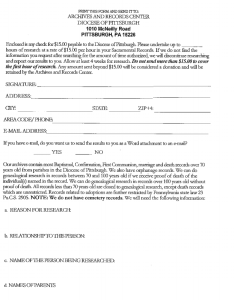
RecordsSearchIt’s almost a decade since I started unraveling this tale, and I still have a gaping hole in my timeline of events. From Severina’s death in 1917 until Mary, Phil and Joe emerge living with Pasquale in the 1920 Census, the public record on their whereabouts goes silent. And it’s silent again until Phil and Joe get caught up in the headlines concerning the Brenckle fire.
I realize, after scratching around in my paperwork, I never did get around to sending a records request to the one place that could help fill it in: The Diocese of Pittsburgh.

The Diocese has a trove of searchable records, including First Holy Communion and Confirmation records. Now, on their genealogical information page, they try to dissuade you from these records because the information they provide is extremely limited. It’s not worth the $15 search fee, they say.

Glad that they’re so honest, and it might be true if that’s where you’re beginning your search. In the case of Mary, Phil and Joe, a tiny scrap of fact could crack open a world of information. Mary would have been seven or eight at the time of her First Holy Communion. This is probably the last family event the Venezias would have experienced together.

My grandfather and Joe’s First Holy Communions would have been during a more tumultuous time, around the era of their mother’s remarriage and death. But it’s the Confirmation records that have real merit. All three Confirmations would have occurred in the period after they were orphaned, but before they came to live at the Brenckles.

The Diocesan collection offers a final tantalizing bit of possibility: Orphanage records. I have requested they search all their records for Phil and Joe, from 1920-1923. Whether they can do that legally under Pennsylvania law, I don’t know. The worst they can say is no.

In one of my old childhood diaries, I dedicated a few pages to Grandpa’s story. I interviewed Grammy (yes, I’ve been a reporter since I was, like, 9), asking for a full recounting of her memories. When I asked about the orphanage, Toner Institute is the name she came up with. It seems too specific to be wrong, but once I started researching it never made sense. While it was a home for boys, it was in Brookline, over near Mt. Lebanon, far from Pittock. What’s more, how could a child placed at an orphanage over there end up at a farm in Troy Hill? But I’ll readily admit that I don’t know the mechanics of Allegheny County’s farming out policies. More likely choices seem to be St. Anthony’s (for orphans of Italian descent, but all the way over in Oakmont), St. Paul’s Orphan Asylum (Crafton), or the orphanage it merged with, Holy Family Institute (Avalon, all the way across the Ohio River, but directly opposite Pittock). An outlier is St. Joseph’s. It’s located in Troy Hill, but seems to have catered to German orphans.

I’m putting the letter in the mail tonight, and then it will take four weeks to fulfill the request. I’ll keep my fingers crossed.

Probate, Wills and a special place in hell

It’s three days into the massive Ancestry data dump known as the Probate Records collection and, of course, I’ve been spending every spare second searching the Venezias and Brescias.

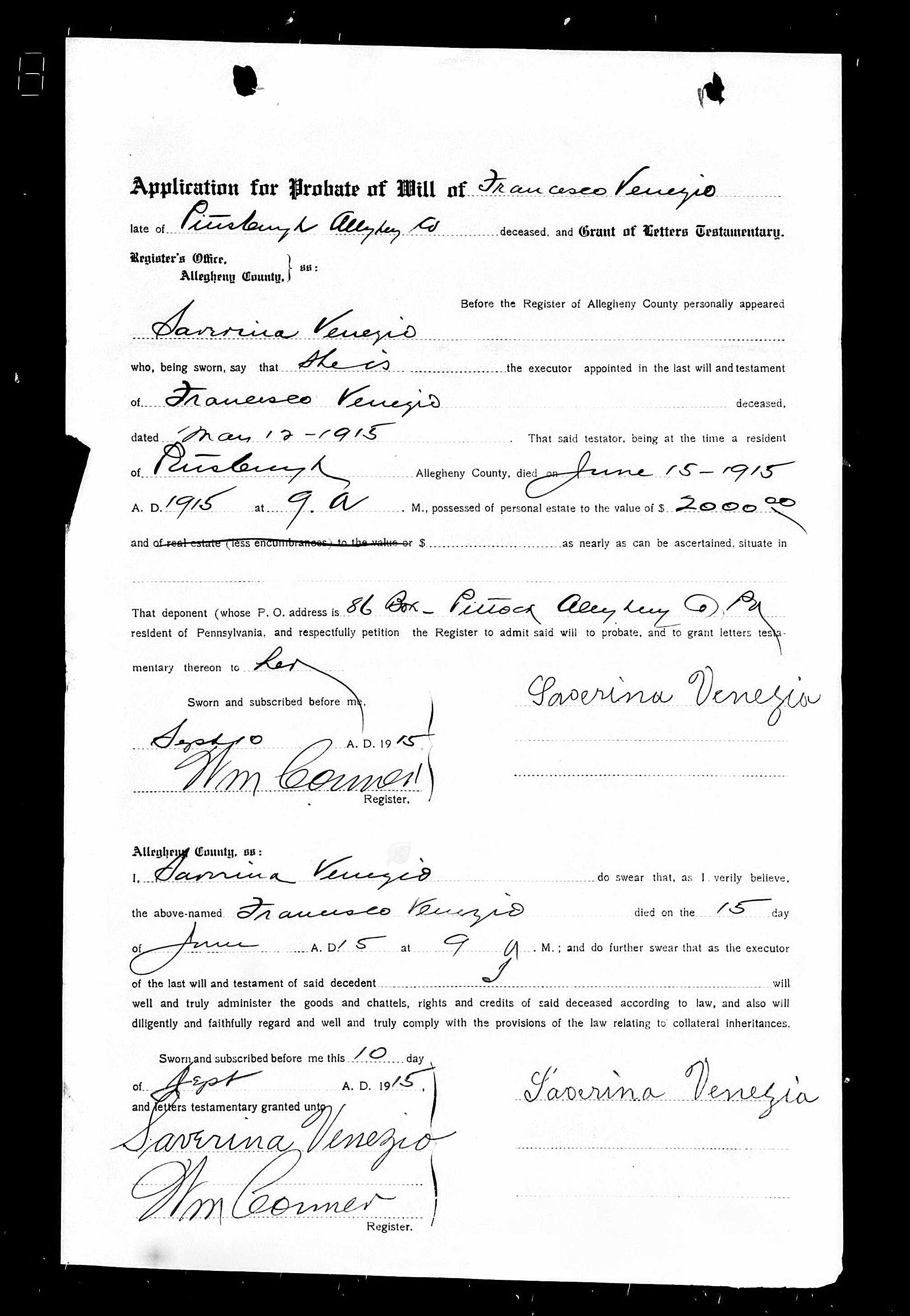
I start with Francesco, and there’s no surprise there. The heart-stopping Last Will and Testament of Francesco Venezia I found almost a decade ago is now preserved forever online.

SeverinaExecutrixRe-reading it, I caught a sentence that I skipped over in the past. Francesco not only gave Severina money immediately, his will stipulated that the interest income from the kids’ equal shares be given to her annually until Mary, Phil and Joe all reached the age of 21. The form values the estate at $2,000 (the equivalent buying power of $46,000 today.) This information once again swings the needle on my feelings about Severina and her second husband, Mike Natale. In my mind, she didn’t have to jump into a marriage with a guy six months later. She, quite frankly, didn’t even have to die at such a young age. Oh, Severina. What happend to all that money Francesco worked so hard to leave you?

The executrix letters indicate Severina’s address as a PO Box in Pittock. Pittock. There it is again. Two years later, when she dies, her address is Enterprise Street, back in the old neighborhood of East Liberty. Did she go to live with Pasquale in the interim? Francesco’s address prior to being admitted to the hospital was Frankstown Avenue. Why would she have an address on virtually the other side of the city? It’s not easy to get from East Liberty to Pittock now. I can’t imagine it was easier in the early 20th century. The only explanation I can think of is that as Francesco realized he was in the final stages, he sent his family away. The only place they could go was to Pasquale, particularly if Antonio was the one who agreed to care for Francesco.

There are a few other collateral papers that I hadn’t seen before that provide a smidge of color

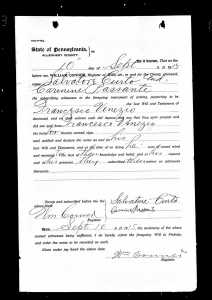
Witness letters

and context into Francesco’s will. The two witnesses, Carmine Passante and Salvatore Curto, submitted the will for probate on Sept. 10, 1915. Unlike some records in the collection, there is no indication of the personal property Francesco left behind. Man, I would have loved to have an actual list of things my great-grandparents owned.

I also wonder about these two men. Surely, they had to have been very close friends of my great-grandfather’s if he trusted them to carry out the important duty of legally executing his will. Jason and I had our wills done this summer, and let me tell you, it makes you seriously examine who you trust. It’s interesting that Francesco does not choose Antonio for any of these duties. He certainly isn’t asking the Brescia brothers. I also find it interesting, though I’m not sure how unusual, that Francesco makes his wife the executrix of his estate. This is five years before women even have the right to vote. He obviously trusted her beyond all others. How deeply she let him down, squandering his hard-earned cash on a shiftless and unworthy man.

After several unsuccessful serches in the Ohio probate records for the mysterious Ohio uncle, my thoughts turn to Mike Natale. OK, boss. You got our cash. What’d ya do with it?

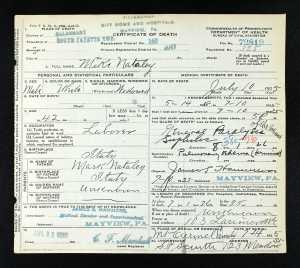
Mike Nataley Mayview 1920

No wills. But in turning back to my Shoebox’d record of the Mike Nataley in the Mayview Insane
Asylum, another new Ancestry feature points me to a stunning revelation. The new site more clearly links records that may be associated with people you’re searching — including those in the Shoebox purgatory. In this case, it’s a Death Record.

Same man. An Italian widow. Same birth year. A previous address in the same section of my family’s East Liberty neighborhood. The undertaker who took the body was located on Meadow Street, only a few blocks from Our Lady Help of Christians. A burial at Mount Carmel Cemetery. Cause of death? General paralysis of the insane. Secondary cause — sulpulus? What’s sulpulus?

A quick churn through Doctor Google and I’m slapping my hand over my mouth. Syphills. Oh my god. He went insane from syphills. Contracted on or about the time immediately adjacent to Severina’s pregnancy and death. That total bastard.

Mike Nataley DC

If this is really our Mike Natale (and I shudder to call him that), it explains so much. The stillborn baby. Possibly even the infection that killed Severina (though it’s possible it was just a general infection very common at the time.) It explains why he was likely abusive (the precursuor to the full-blown condition includes massive personality changes, violence and delusions of grandeur.) It explains why he left Mary, Phil and Joe twisting in the wind.

For the first time in a long time, Pasquale is starting to look like the slightly better man.

After spending a few minutes quietly fuming on my grandpa’s behalf, my thoughts to turn to Marion Drost, the female counterpart to Phil in the fire drama.

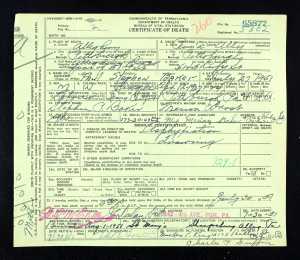
MarionsSonDC

It takes some digging, but I prove that the Marion Baker I’ve found in the census records is indeed Marion Drost. Sadly, it takes her 24-year-old son’s death certificate to do it. Paul Stephen Baker, the son of Marion and Stephen, apparently drowned in the Allegheny River. He was a veteran of the Korean Conflict and still in service at the time of his death. My heart cracks open anew for poor Marion. I can’t tell if she had other children. I’ll be using my new subscription to Newspapers.com to see if this death made the news (I can’t imagine it wouldn’t) or if I can find an obit.

All these revelations once again have me thinking about the forces that have shaped my present reality. The only conclusion I can draw is that we’re freaking lucky, blessed or all of the above. Somebody, somewhere is watching out for us all.

Blog at WordPress.com.

Up ↑