Search

findingphilblog

In search of my grandfather's past … and maybe a book deal

Tag

Marion Drost

Probate, Wills and a special place in hell

It’s three days into the massive Ancestry data dump known as the Probate Records collection and, of course, I’ve been spending every spare second searching the Venezias and Brescias.

I start with Francesco, and there’s no surprise there. The heart-stopping Last Will and Testament of Francesco Venezia I found almost a decade ago is now preserved forever online.
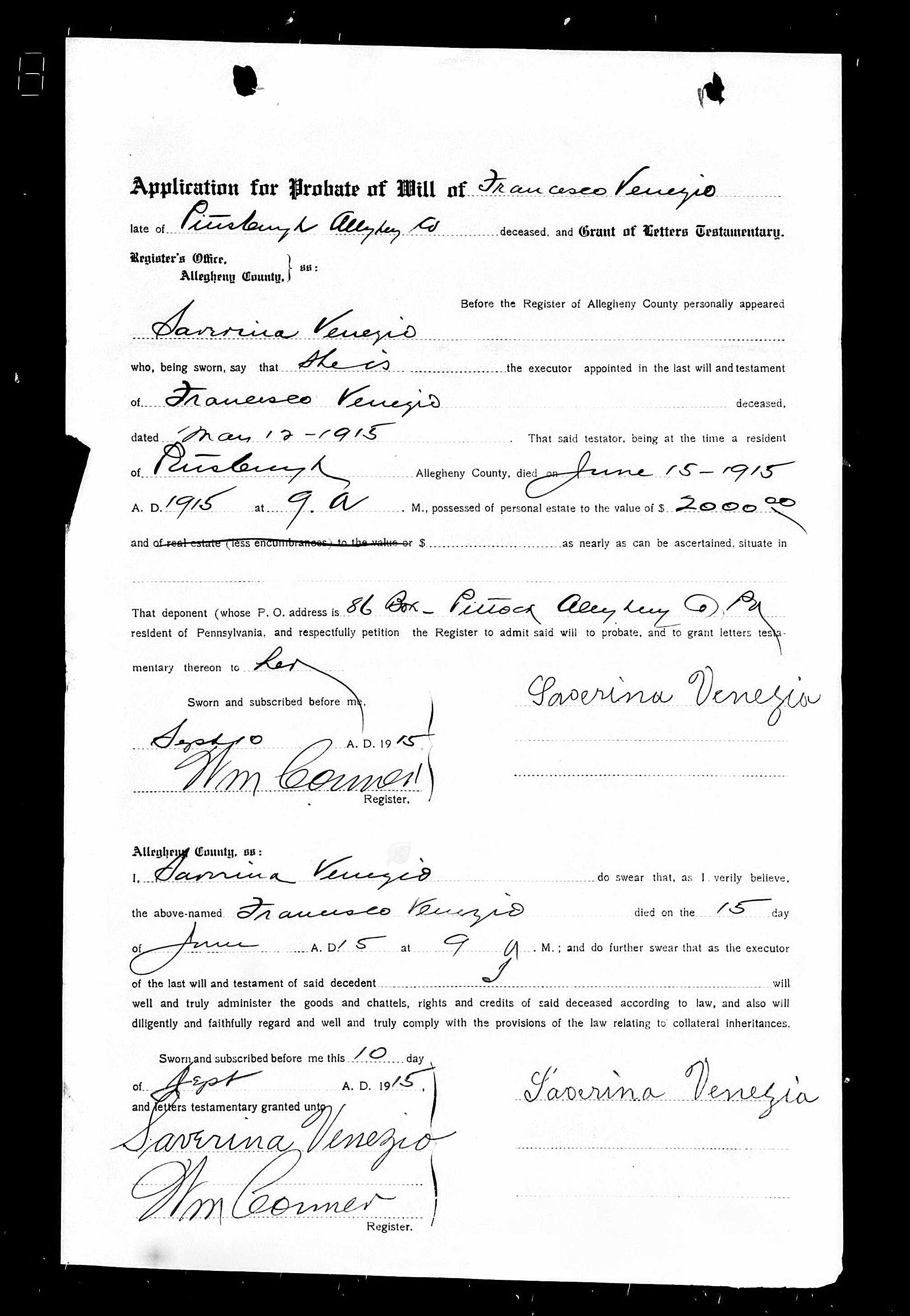
SeverinaExecutrixRe-reading it, I caught a sentence that I skipped over in the past. Francesco not only gave Severina money immediately, his will stipulated that the interest income from the kids’ equal shares be given to her annually until Mary, Phil and Joe all reached the age of 21. The form values the estate at $2,000 (the equivalent buying power of $46,000 today.) This information once again swings the needle on my feelings about Severina and her second husband, Mike Natale. In my mind, she didn’t have to jump into a marriage with a guy six months later. She, quite frankly, didn’t even have to die at such a young age. Oh, Severina. What happend to all that money Francesco worked so hard to leave you?

The executrix letters indicate Severina’s address as a PO Box in Pittock. Pittock. There it is again. Two years later, when she dies, her address is Enterprise Street, back in the old neighborhood of East Liberty. Did she go to live with Pasquale in the interim? Francesco’s address prior to being admitted to the hospital was Frankstown Avenue. Why would she have an address on virtually the other side of the city? It’s not easy to get from East Liberty to Pittock now. I can’t imagine it was easier in the early 20th century. The only explanation I can think of is that as Francesco realized he was in the final stages, he sent his family away. The only place they could go was to Pasquale, particularly if Antonio was the one who agreed to care for Francesco.

There are a few other collateral papers that I hadn’t seen before that provide a smidge of color
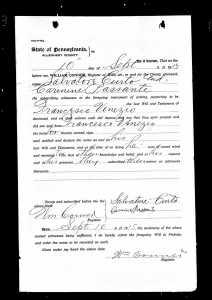
Witness letters

and context into Francesco’s will. The two witnesses, Carmine Passante and Salvatore Curto, submitted the will for probate on Sept. 10, 1915. Unlike some records in the collection, there is no indication of the personal property Francesco left behind. Man, I would have loved to have an actual list of things my great-grandparents owned.

I also wonder about these two men. Surely, they had to have been very close friends of my great-grandfather’s if he trusted them to carry out the important duty of legally executing his will. Jason and I had our wills done this summer, and let me tell you, it makes you seriously examine who you trust. It’s interesting that Francesco does not choose Antonio for any of these duties. He certainly isn’t asking the Brescia brothers. I also find it interesting, though I’m not sure how unusual, that Francesco makes his wife the executrix of his estate. This is five years before women even have the right to vote. He obviously trusted her beyond all others. How deeply she let him down, squandering his hard-earned cash on a shiftless and unworthy man.

After several unsuccessful serches in the Ohio probate records for the mysterious Ohio uncle, my thoughts turn to Mike Natale. OK, boss. You got our cash. What’d ya do with it?

Mike Nataley Mayview 1920

No wills. But in turning back to my Shoebox’d record of the Mike Nataley in the Mayview Insane
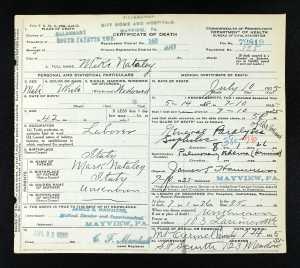
Asylum, another new Ancestry feature points me to a stunning revelation. The new site more clearly links records that may be associated with people you’re searching — including those in the Shoebox purgatory. In this case, it’s a Death Record.

Same man. An Italian widow. Same birth year. A previous address in the same section of my family’s East Liberty neighborhood. The undertaker who took the body was located on Meadow Street, only a few blocks from Our Lady Help of Christians. A burial at Mount Carmel Cemetery. Cause of death? General paralysis of the insane. Secondary cause — sulpulus? What’s sulpulus?

A quick churn through Doctor Google and I’m slapping my hand over my mouth. Syphills. Oh my god. He went insane from syphills. Contracted on or about the time immediately adjacent to Severina’s pregnancy and death. That total bastard.
Mike Nataley DC

If this is really our Mike Natale (and I shudder to call him that), it explains so much. The stillborn baby. Possibly even the infection that killed Severina (though it’s possible it was just a general infection very common at the time.) It explains why he was likely abusive (the precursuor to the full-blown condition includes massive personality changes, violence and delusions of grandeur.) It explains why he left Mary, Phil and Joe twisting in the wind.

For the first time in a long time, Pasquale is starting to look like the slightly better man.

After spending a few minutes quietly fuming on my grandpa’s behalf, my thoughts to turn to Marion Drost, the female counterpart to Phil in the fire drama.
MarionsSonDC

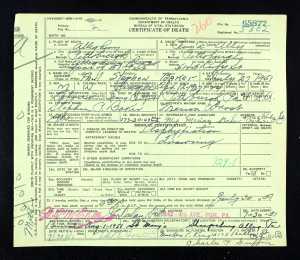
It takes some digging, but I prove that the Marion Baker I’ve found in the census records is indeed Marion Drost. Sadly, it takes her 24-year-old son’s death certificate to do it. Paul Stephen Baker, the son of Marion and Stephen, apparently drowned in the Allegheny River. He was a veteran of the Korean Conflict and still in service at the time of his death. My heart cracks open anew for poor Marion. I can’t tell if she had other children. I’ll be using my new subscription to Newspapers.com to see if this death made the news (I can’t imagine it wouldn’t) or if I can find an obit.

All these revelations once again have me thinking about the forces that have shaped my present reality. The only conclusion I can draw is that we’re freaking lucky, blessed or all of the above. Somebody, somewhere is watching out for us all.

The 1940 Census is here!!

Census1940In business-ese, digging into something and spending a lot of time with it has a jargon-y phrase: taking a deep dive.

Well, I’ve been scuba-diving in the 1940 Census since it was released a few days ago.

It’s not exactly relevant to my writing project. It’s more like a roadmap for what happens next. If writing is about building a story arc, then these bits of information might help me craft scenes that allude to something that may not happen for a decade, but still matter. And besides, if I see where they go, it will help me stitch together the path of how they got there.

Of course I had to look up Grandpa first. What I found is interesting. He’d moved out on his own. He was listed as a lodger at a boarding house on Lockhart Street. It doesn’t exist anymore. The street dead-ends under bridge on the North Shore. It’s interesting that Grandpa’s noted as having zero education. I’d always heard he’d never gotten beyond 8th grade. But it looks like the census man spoke with him directly. Hmm. I was happy to see he worked all year in 1939 as a “produce man” (I suppose that could be an abbreviation for manager or it could just be produce man). But that he’d made only $1000 for all his effort. It sounds abominable, but in reality, it was on the lower end of middle class. I figure he had a lifestyle very similar to the one I had when I was single and working for my first newspaper. You were OK, but you really hoped no big bills or unexpected circumstances hit.

I wonder how he felt, living alone. I know that when I shut the door on the first day of living in my first apartment, I was so excited to be in charge of everything. Seems crazy now, of course. Haha. But I wonder how a guy, who’d spent his entire life making sure his family stayed together, felt to finally have a little bit of space for himself. His little brother was married. His sister was being taken care of at the Fresh Air Home. Maybe he just relaxed a little. I hope he had some fun. I hope he went out at night, had girlfriends and found something interesting to do in his spare time. Maybe that’s when he learned to play the concertina!

As we know, Joe and Ruth got married in 1932, so they were out of the Brenckles house, too. They lived in the rear of Ruth’s mother’s house. They had been living there at least five years, too. Joe is a laborer in Retail Food. I’m not sure if that means he’s slinging produce boxes at Donahoe’s with Phil, if he’s working for the Brenckles’ stand or something else.

I also looked up Marion, to see if she was still hanging on. She was. She was still in her house on Ruby Way, but with one more kid. And her brothers were still living with her, although it seems that this person who’s doing the correcting to their posts has made the boys Stephen’s brothers. Their names are also misspelled, but misspelled in the same way they were a few times in the fire coverage. Grost. In fact, the cursive D looks like a G, so the Ancestry algorithm could just be picking up the variation.

Either way, by the eve of World War II, it looks as if everyone had put the events of the past behind them. They were, after all, a solid 17 years behind. For grandpa, it was actually pretty significant. He was 16 when it happened. He was now moving into a future where he was a full lifetime removed from all the troubles of his childhood.

When I think about Phil’s life, sometimes I think of Andy Dufresne from the ‘Shawshank Redemption’ and the line in the movie, as Andy’s escaping: *Morgan Freeman voice* “Andy Dufresne, who crawled through a river of shit and came out clean on the other side…’

That’s about right.

Look who’s back, back again

Yeah, I kinda flaked for a year there on my postings.

To be honest, my research shut down as I conducted two more vital ones. The search for a new job (my choice, don’t worry!) and a new house (because it was time).

I’m happy to report that both were successful. I’ve got a new gig in Corporate America where I will continue to write, but in a different format and style. And Jason and I, after three years, finally found a place to call our own. Thanksgiving 2010 was spent binge-researching at the Carnegie Library. Thanksgiving 2011 found me elbow deep in paint and spackle.

But now that things have finally calmed down at work and on the homefront, I’ve gone back to my evenings in front of the TV, where I “Play along at home” as I watch ‘Who Do You Think You Are?’ The first episode of the season was Friday (Martin Sheen) and I dug into the website after the show.

Saturday’s mission was seeing if I could find out what happened to the Drost kids. Marion, Frank, Thomas and Joseph survived the fire just as Phil and Joe did. Surely, they had scars from that ordeal, and likely more deeply because they lost their sister. Phil, miraculously, kept his sibling.

So, I started poking around. I found the family easily enough in the 1910 Census. Their father was also Frank. And he was an iceman in this family snapshot. Interestingly enough, there is the children’s mother, Teresa. The family appears to be of Polish-German origin, which means over the next two censuses, their national identity will change at least twice as the boarders shift due to war.

But a decade later, Teresa is gone. Frank, as the papers had said, was a police officer for the city. Interesting. I look up at the date on the census. It was recording literally the month before his children became wards of the Allegheny County Juvenile Court. A policeman. With four kids in county care. That alone would be front-page news today.

It’s hard to find big Frank, but by 1930, I think I may have found Marion and little Frank, along with Thomas.

If it is the same family, Marion is now Mrs. Marion Baker, with a young son named Paul who is almost 3 (quick math, NO he is not Howard Lager’s). Frank Drost and Thomas Drost (correct ages) are living with them and recorded as being brothers of the head of household, a title Marion and her husband Stephen seem to share. He’s recorded as Head, but there’s an H next to her name.

Again, though, I can’t be 100 percent sure because someone has used the feature Ancestry gives you to allow corrections to historic documents. I could have made one, for instance, when I saw how badly Pasquale’s name was misspelled in the 1920 Census.The corrected name is something else entirely, which holds me back from believing this is the outcome for Marion and her siblings.

I hope it is. Because that would mean that she at least (I hope) found peace and a home of her own. Her husband is a steelworker, and if Stephen’s personal history held to the wider arc, that would mean the family probably found a solid, middle-class life. And, just like Phil, she managed to keep her immediate family together.

Thankful for the Carnegie Library — Again

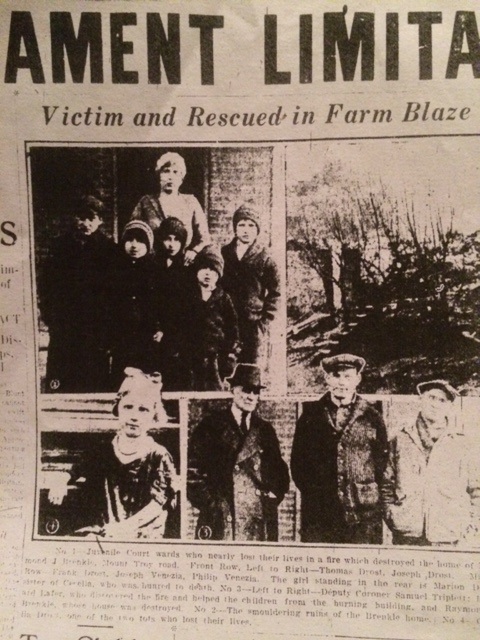
DispatchPhotoLook at this. Just look at it. I’ve had it in my possession for two days now and I can’t stop staring at it.

This is the first time I’ve seen my grandfather this young. And oh, what a picture it is. It was on the front page of the Pittsburgh Dispatch. It was taken the morning after the fire.

You may not be able to see it very well, but that’s Phil on the far left. Joe, Marion Drost and her brothers, are all standing in front of steps that go to the shell of the burned out house. I stare and stare at Grandpa’s face. In spite of the blur, I can see the despair in his eyes. His jaw is clenched.

Of all the material I found over the last 48 hours, this is the most amazing.

I knew the story was front-page, but a photo like that makes it so viscerally real to me. How many times have Jason and I been on the opposite side of the lens? I feel like I can see the scene going on all around the edges of this picture so clearly.

I won’t be able to link the material I found because I copied it all off microfiche and it doesn’t look like any of the other papers were part of the Google News Archive project. I’ll just have to summarize.

Pittsburgh had half a dozen major newspapers that covered the area. How they approached the story depended on their proximity and, to be honest, objectivity. Some, like the Press and the Gazette, were pretty straightforward. The Dispatch, News Chronicle and Sun, along with a few others, were a more lurid in their coverage. And one paper, I forget which one, got so much wrong in the initial report that I was glad the reporter’s name wasn’t memorialized. I’d have been mortified.

But all that helped me get a much clearer picture of what happened that night because certain facts are consistent throughout the reporting.

They include:

  • Howard Lager being on the phone with a woman who was not his wife at about midnight on the night of the fire (he was married at the time, but his wife and child were living elsewhere.)
  • Howard sounding the alarm that roused the house
  • Howard waking Phil first and the two of them fighting the fire in the kitchen together with pitchers.(This fact just wrenched my heart. He must have been terrified. The fact he escaped out the kitchen window made it all the more harrowing.)
  • Howard going back upstairs through the flames to rescue his niece and nephew (Anna Mae and Buddy). He saved them and himself by tossing the kids down to Raymond and then climbing down a porch support.
  • A central furnace had just been installed in the house. Howard recalled the vents on the floor were hot as he passed over them and there was an odor of “varnish” in the air near them.
  • Phil and Joe corroborating Howard’s statement of the night’s events when on the stand during the inquest.

There were also some very interesting revelations:

  • The Brenckles had homemade wine and were drinking it that evening. This was during the height of Prohibition. Homemade wine was allowed, but of course anyone who drank was vilified.Oopsie.
  • There was a fight on the evening before the fire between Myrtle, Howard and Cecilia over a ring. Howard had apparently given it to Cecilia (uh…). Myrtle was flipping out over it. Cecilia returned the ring that evening.
  • No one saw Cecilia after she went upstairs to bed. She never made it out of the house.
  • There was confusion among the fire companies over who covered the fire. The property is between Reserve and Ross. The call to their version of 911 went into the city first. There was a significant delay in getting help out to the house.
  • John Orlowski may have gone back into the house because he wanted to rescue his dog. I can’t even think about how sad that is right now.
  • The Coroner was really, really hard on Raymond Brenckle. He all but accused the Brenckles of letting the kids burn while they worried about their own family.
  • The county’s Juvenile Court System was on trial, too. A number of the papers made some pretty good hay out of renting kids out for farmwork. The county paid about $5 a week for their care. When the trial concluded without an indictment, there were lots of speeches and pronouncements about how the District Attorney and President Judge would keep investigating, demanding answers. Yadda. Yadda. Yadda. I’ve sat now about 60 hours in front of mircrofiche and intranet search. I don’t see a scintilla of follow-up on this case. At least, until the next tragedy.

I’m in Pittsburgh to celebrate Thanksgiving with Mary Ann, Mike and my cousins, so it’s been incredible sharing these revelations with them. And I’m feeling even more thankful that none of us ever had to live through something like this.

Blog at WordPress.com.

Up ↑