Search

findingphilblog

In search of my grandfather's past … and maybe a book deal

Tag

Mike Natale

Probate, Wills and a special place in hell

It’s three days into the massive Ancestry data dump known as the Probate Records collection and, of course, I’ve been spending every spare second searching the Venezias and Brescias.

I start with Francesco, and there’s no surprise there. The heart-stopping Last Will and Testament of Francesco Venezia I found almost a decade ago is now preserved forever online.
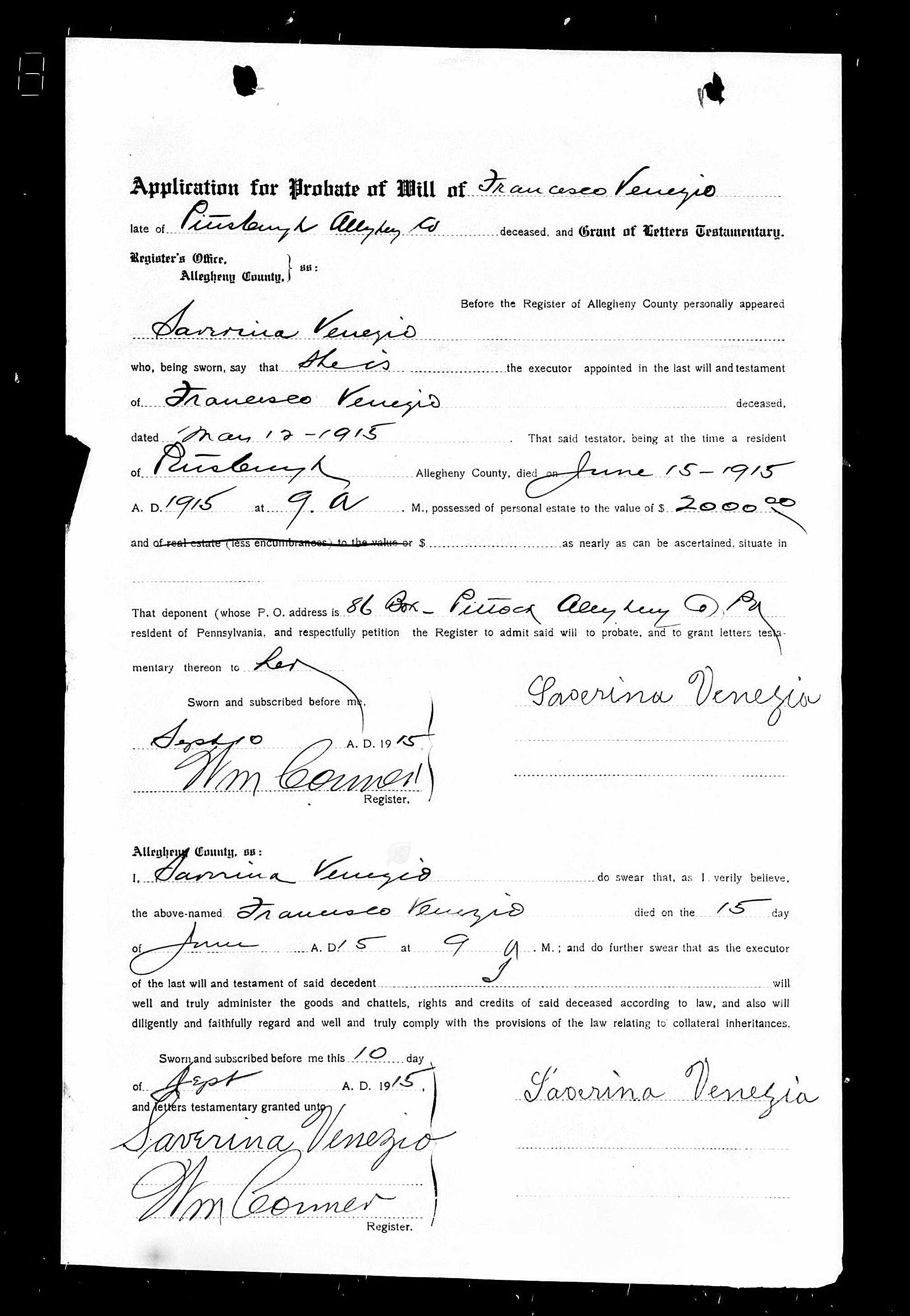
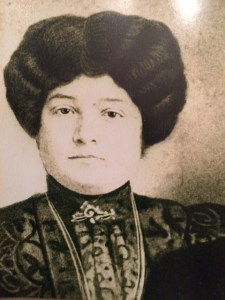
SeverinaExecutrixRe-reading it, I caught a sentence that I skipped over in the past. Francesco not only gave Severina money immediately, his will stipulated that the interest income from the kids’ equal shares be given to her annually until Mary, Phil and Joe all reached the age of 21. The form values the estate at $2,000 (the equivalent buying power of $46,000 today.) This information once again swings the needle on my feelings about Severina and her second husband, Mike Natale. In my mind, she didn’t have to jump into a marriage with a guy six months later. She, quite frankly, didn’t even have to die at such a young age. Oh, Severina. What happend to all that money Francesco worked so hard to leave you?

The executrix letters indicate Severina’s address as a PO Box in Pittock. Pittock. There it is again. Two years later, when she dies, her address is Enterprise Street, back in the old neighborhood of East Liberty. Did she go to live with Pasquale in the interim? Francesco’s address prior to being admitted to the hospital was Frankstown Avenue. Why would she have an address on virtually the other side of the city? It’s not easy to get from East Liberty to Pittock now. I can’t imagine it was easier in the early 20th century. The only explanation I can think of is that as Francesco realized he was in the final stages, he sent his family away. The only place they could go was to Pasquale, particularly if Antonio was the one who agreed to care for Francesco.

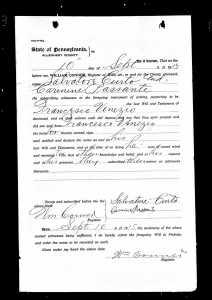
There are a few other collateral papers that I hadn’t seen before that provide a smidge of color
Witness letters

and context into Francesco’s will. The two witnesses, Carmine Passante and Salvatore Curto, submitted the will for probate on Sept. 10, 1915. Unlike some records in the collection, there is no indication of the personal property Francesco left behind. Man, I would have loved to have an actual list of things my great-grandparents owned.

I also wonder about these two men. Surely, they had to have been very close friends of my great-grandfather’s if he trusted them to carry out the important duty of legally executing his will. Jason and I had our wills done this summer, and let me tell you, it makes you seriously examine who you trust. It’s interesting that Francesco does not choose Antonio for any of these duties. He certainly isn’t asking the Brescia brothers. I also find it interesting, though I’m not sure how unusual, that Francesco makes his wife the executrix of his estate. This is five years before women even have the right to vote. He obviously trusted her beyond all others. How deeply she let him down, squandering his hard-earned cash on a shiftless and unworthy man.

After several unsuccessful serches in the Ohio probate records for the mysterious Ohio uncle, my thoughts turn to Mike Natale. OK, boss. You got our cash. What’d ya do with it?

Mike Nataley Mayview 1920

No wills. But in turning back to my Shoebox’d record of the Mike Nataley in the Mayview Insane
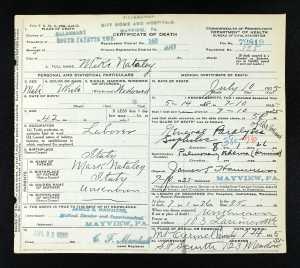
Asylum, another new Ancestry feature points me to a stunning revelation. The new site more clearly links records that may be associated with people you’re searching — including those in the Shoebox purgatory. In this case, it’s a Death Record.

Same man. An Italian widow. Same birth year. A previous address in the same section of my family’s East Liberty neighborhood. The undertaker who took the body was located on Meadow Street, only a few blocks from Our Lady Help of Christians. A burial at Mount Carmel Cemetery. Cause of death? General paralysis of the insane. Secondary cause — sulpulus? What’s sulpulus?

A quick churn through Doctor Google and I’m slapping my hand over my mouth. Syphills. Oh my god. He went insane from syphills. Contracted on or about the time immediately adjacent to Severina’s pregnancy and death. That total bastard.
Mike Nataley DC

If this is really our Mike Natale (and I shudder to call him that), it explains so much. The stillborn baby. Possibly even the infection that killed Severina (though it’s possible it was just a general infection very common at the time.) It explains why he was likely abusive (the precursuor to the full-blown condition includes massive personality changes, violence and delusions of grandeur.) It explains why he left Mary, Phil and Joe twisting in the wind.

For the first time in a long time, Pasquale is starting to look like the slightly better man.

After spending a few minutes quietly fuming on my grandpa’s behalf, my thoughts to turn to Marion Drost, the female counterpart to Phil in the fire drama.
MarionsSonDC

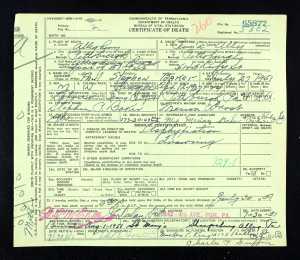
It takes some digging, but I prove that the Marion Baker I’ve found in the census records is indeed Marion Drost. Sadly, it takes her 24-year-old son’s death certificate to do it. Paul Stephen Baker, the son of Marion and Stephen, apparently drowned in the Allegheny River. He was a veteran of the Korean Conflict and still in service at the time of his death. My heart cracks open anew for poor Marion. I can’t tell if she had other children. I’ll be using my new subscription to Newspapers.com to see if this death made the news (I can’t imagine it wouldn’t) or if I can find an obit.

All these revelations once again have me thinking about the forces that have shaped my present reality. The only conclusion I can draw is that we’re freaking lucky, blessed or all of the above. Somebody, somewhere is watching out for us all.

Baby Girl Natale

NataleInfantCaptureThis is such a hard post to write. The title of the post is a warning; so, if these types of things are hard for you, read no farther.

For so many years, I’ve wondered what happened to the child my great-grandmother had just before she died. I’d hoped that somehow the child survived and there was a branch of our family just waiting to be discovered.

Now I know that was never to be the case. A few days ago, Pennsylvania released an enormous collection of death records, from 1906-1963. What I wrote away for all those years ago is now available right on my Ancestry page.

The baby, never named, was stillborn on Dec. 28, 1916. It was a girl. For some reason, I had always pictured the child as a boy. In fact, in my book, the child is a boy because I felt so strongly that she would have another son. Further proof, I guess, that your strongest assumptions can be total errors.

My heart cracks in half. I am writing this with my daughter’s monitor perched by my side, watching her sleeping peacefully. Mommy is hugging her extra hard tonight. I don’t care if I wake her up.

There is such a potent rush of emotions that occur when you give birth. I know the joy of seeing that little face held up for the first time, hearing her cry and know that the two of you — mother and child — have just come through the danger (no matter how modern the medicine or healthy you are) together.

The form does not indicate on the form the reason for the stillbirth, so we don’t know if the baby was premature, had some type of birth injury or was born in circumstances that prenatal care, fetal heart monitoring, C-sections and other basic medical interventions mostly prevent these days.

I also know why there was no body with Saverina at Mount Carmel. The child was buried in Calvary Cemetery. I will be calling them in the next few days to see what information they might have. It’s possible this is a potter’s field burial, with no stone and very little information.

This information again shifts my extremely conflicted feelings about Mike and Saverina. For all I feel they did wrong (not keeping the siblings together), it’s possible that the lens of grief led to decisions that perhaps were not fully thought through. I can’t blame them for that. I also can’t forget that while these types of things were more common in this era — spousal death at a young age and death in childhood or childbirth — they were no less tragic. Grief is different for everyone and no one way is right.

My great-grandmother suffered so much in the two short years between Francesco’s death and her own. The death certificate for the baby notes her maiden name as Saverina Venezia, and I wonder if she never did get over losing him. Because her death occurred in such a short period of time, she also never got the redemption that sometimes comes with years and understanding. I am hoping, at least, that the faith she had was her final comfort.

The Stepfather

Since I discovered his existence, I’ve been curious about Mike Natale. I wondered about the man he was, what motivated him and, most importantly, what compelled him to walk away from three children who’d just lost their mother.

There are plenty of good men out there who step up to the plate and raise other people’s children — whether they’re uncles, stepfathers, grandfathers or good friends. Why was Mike Natale not among them? Heck, even Pasquale, such as he was, took his niece and nephews in.

I’ve found no indication that the siblings remained with Mike after their mother died. And if she was in the hospital for a month, it could be possible they were shipped to Pasquale’s before that.

Natale is a hard name to trace because there are many, many, many Natales. With a first name like Michele (Mike), it’s is even harder. I at least have his birthdate from the marriage record in 1916.

So, I do what so often ends up working for me. I Google and Ancestry until I come up with … something.

What I found tonight could offer an enormous explanation. Once again, it was a variation of the name (which you can set filters for on Ancestry) that brought up the hit.

If it’s true, it adds a whole new dimension to my grandfather’s brief life with his stepfather.

You see, the Mike Nataley I found, who was Italian, the correct age, was a widower and living in Allegheny County was, in 1920, living in an insane asylum.

If this is indeed the same man who for a year was Phil’s stepfather, it would go a long way to explaining why he didn’t, or perhaps couldn’t, take care of the siblings. It also creates a very sobering picture of what life might have been like for my grandfather in his home.

And it becomes even harder to judge “what kind of man” this stepfather was in light of this information. He could have been undone by grief and been dealing with a variant of depression. Mental illness was so incredibly misunderstood in this era people were locked up for things we treat successfully with talk therapy and medication today. He also truly could have had something very serious such as schizophrenia or bipolar disorder, which even today can require hospitalization. He could have been an addict. I don’t know. And what’s more, I don’t know if this Mike Natale(y) is our Mike.

So I’m Shoeboxing it until I find further supporting evidence.

And I’m left to wonder. Not just about Mike, but one of the perpetual questions of my search. What happened to Mike and Saverina’s baby?

The Hall of Records: Marriage edition

I’m at a bit of a dead end with the money angle. But, I realized I was missing another huge trove of records. Marriage licenses.

SeverinaSo, early this morning, I trundled into the Marriage License Bureau to start my digging there.

The woman suggested I start with the bride’s name, so down came the big book of Bs and I turned to 1904, the year (I presumed) Francesco and Severina had been married. But the search came up empty. I checked the year before and after, just to be sure. Nothing. Which leads me to believe that they’d probably gotten married in Italy and come over here.

I figured while I was in the Bs, I’d look for Raymond and Myrtle Brenckle, my adoptive great-grandparents. As expected, there they were. Raymond Brenckle and Myrtle Lager. I made a photocopy. Everyone’s coming over to our house for Easter, so I figured this would add to the show-and-tell fun.

As I stood there, trying to figure out where to look next, from the corners of my brain, a tiny memory fluttered up. Severina had either died of the flu in the pandemic, or she’d died in childbirth. There may have been a stepfather.

If there was a stepfather, there had to have been a marriage, right?

The will I’d found indicated Francesco had died in June 1915, so I started with July.

My heart dropped when I reached January 1916.

“Severina Brescia and Michele Natale,” I whispered to myself. “You’ve got to be kidding me. Six months? She waited six months?! Francesco’s body was barely cold!”

From “beloved wife” and widow to new bride in 180 days.

I know it’s wrong to judge people of the past by today’s morality and mores. But a part of me is really angry at her. How could she put her kids through that? My poor grandpa! What’s more, all of a sudden this vague notion of my great-grandmother dying in childbirth has suddenly taken on a whole lot more relevance. Was there really a baby?

I copied the certificate and walked back across the street in a haze.

“She waited six months!” I shouted into the phone when I relayed my news to my parents during my walk back. “Six months and she married some new guy. Looks like the neighbor. Their addresses were only a few digits apart. I can’t believe it.”

“It was 1916, honey,” my mom said. “It was probably that or starve.”

“I know,” I said. “But she had money. Francesco left her enough to buy a house, for pete’s sake!”

“How far do you think it went with three kids?” my mom asked gently.

I sighed. She was right and I felt bad. Bad for judging my great-grandma for making a choice I would never have to consider. She was a poor woman with no education. Hell, women didn’t even have the right to vote yet. I shouldn’t be so hard on her.

Later, I calmed down and really took a good look at the material. They’d applied for the marriage license at Christmastime 1915 and had gotten married at a church called Our Lady Help of Christians, which was the same church that issued Grandpa Phil’s baptismal certificate. A quick search of the archives on the Diocese of Pittsburgh website showed me this had been the center of Italian immigrant faith life in East Liberty. The church was still standing, but the congregation had been absorbed a decade ago.

I’d seen that they’d been neighbors, so I tried to find Enterprise Street on Google. It still existed, but it seemed the house didn’t.

Fading to ghosts.

Where do I go from here?

Blog at WordPress.com.

Up ↑